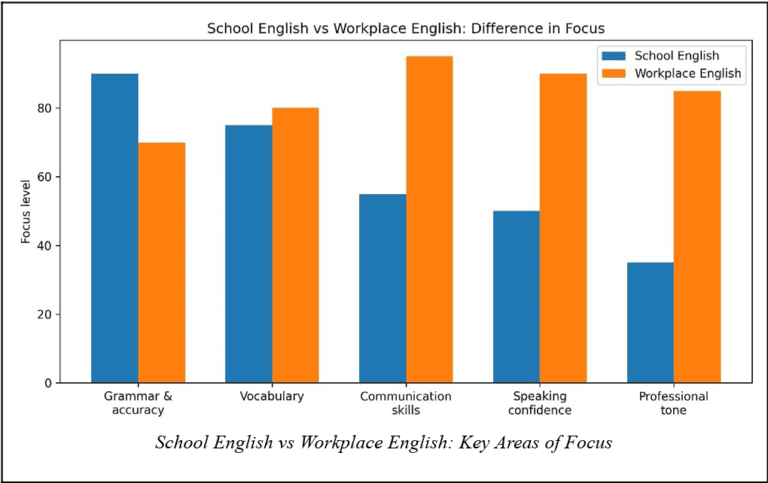
English has been an important part of education for many years. From schools and colleges to professional environments, the language plays a significant role in communication and learning. However, the purpose of using English changes as a person moves from academic life to professional life. Many students spend years studying English in classrooms. They learn grammar rules, vocabulary, reading skills, writing formats, and comprehension techniques. These skills create a strong foundation. However, when many learners enter the workplace, they often realise that workplace English requires a different approach and set of communication skills than those taught in traditional classrooms.
This difference does not mean that school English is unnecessary. In fact, school English provides the basic structure required to understand and use the language. However, workplace English focuses more on application — using the language effectively in real situations. In simple words, school English helps learners understand the language, while workplace English helps professionals use the language as a tool for communication.
Understanding School English
School English is designed to develop a learner’s language foundation. It introduces students to grammar, vocabulary, sentence formation, reading comprehension, and writing skills. The primary purpose of school English is educational development.
Students learn: ● parts of speech ● sentence structures ● grammar rules ● essay writing ● formal letters ● comprehension skills ● literature and texts
These areas help students develop accuracy and familiarity with the language. For example, a student may learn how to use different tenses, how to construct sentences correctly, and how to write an organised paragraph. This knowledge is essential because a person needs a basic understanding of a language before using it effectively. However, the classroom environment is different from the workplace environment. The expectations and communication needs change when a person enters a professional setting.
Understanding Workplace English
Workplace English refers to the practical use of English in professional environments. It is not limited to grammar rules or textbook exercises. Instead, it focuses on communication, collaboration, and achieving professional goals.
In a workplace, people use English to: ● communicate with colleagues ● participate in meetings ● write emails ● present ideas ● interact with clients ● solve problems ● negotiate ● give feedback
Workplace English requires a person to use language according to the situation. A professional may need to explain an idea to a manager, communicate with a client, or discuss a project with a team. In such situations, knowing grammar alone is not enough. The ability to communicate clearly becomes essential.
The Shift From Learning English to Using English in Workplaces
One of the biggest differences between school English and workplace English is the purpose behind communication. In school, students often learn English to complete assignments, answer questions, and perform well in examinations. At workplace, people use English to create understanding and achieve outcomes. For example: A student may write an essay describing an idea. A professional may need to present that idea, explain it to others, answer questions, and convince people about its value. The language remains English, but the purpose changes. This is why many learners who perform well academically may still need practice when they enter professional environments.
Grammar: Important, But Not the Only Goal
School English often gives strong importance to grammar accuracy. This is valuable because grammar helps people communicate correctly. However, workplace communication requires more than grammatical knowledge.
A professional needs to consider: ● Is my message clear? ● Whether my tone appropriate? ● Will the listener understand my intention? ● Am I communicating efficiently?
For example, a grammatically correct sentence may not always be the most effective professional response. Workplace communication requires awareness of the situation. Accuracy supports communication, but communication remains the larger goal.
Vocabulary: From Words to Professional Expression
In school, vocabulary learning often focuses on meanings, spellings, and usage. During professional life, vocabulary becomes more practical. Professionals need words and expressions that help them:
For example, workplace communication often requires phrases such as:
“I would like to suggest…”, “From my perspective…”, “Could we consider another approach?”, “I understand your point; however…”
These expressions help professionals communicate respectfully and effectively. Workplace English is not about using difficult words. It is about using appropriate words.
Speaking Skills: The Biggest Difference in School & Workplace English
One of the biggest gaps between school English and workplace English is spoken communication. Many learners spend years studying English but get limited opportunities to practise real conversations. As a result, they may understand English but hesitate while speaking. Workplace situations require spontaneous communication.
Employees may need to: ● introduce themselves ● participate in discussions ● answer questions ● share opinions ● explain problems ● provide updates
These situations require confidence and practice. Speaking ability develops when learners move from simply studying the language to actively using it.
The Importance of Professional Tone
Another important difference is tone. In school, students are usually communicating with teachers, classmates, and examiners. Meanwhile in workplaces, communication happens with different people:
● managers ● colleagues ● clients ● business partners
Therefore, professionals need to adjust their language. Workplace English requires:
Workplace writing usually needs to be: ● clear ● concise ● organised ● purposeful
A long answer may be acceptable in an academic setting, but workplace communication often values efficiency. Professionals need to communicate information without unnecessary complexity.
Confidence and Communication in Workplace English
Another major difference between school and workplace English is the role of confidence. In academic settings, learners are often evaluated based on correctness.
In professional settings, communication effectiveness becomes equally important. A person may make small mistakes but still communicate successfully if they are confident and clear. Confidence allows professionals to participate, contribute, and express ideas. However, confidence should be supported by continuous improvement. Effective workplace communication develops through regular practice.
Why Students Need Workplace English Communication Training
The transition from education to employment can sometimes feel challenging because the communication expectations change. Although students may know English, they may not know how to use it professionally. As a result, workplace communication training helps learners bridge this gap. Consequently, they can adapt more effectively to professional environments and communicate with greater confidence.
It focuses on: ● interview communication ● presentation skills ● professional vocabulary ● workplace conversations ● email etiquette ● group discussions
Such training prepares individuals to use English beyond classrooms.
English as a Career Skill
In today’s professional world, English is not only a language subject. Instead, it is also a valuable career skill. Moreover, many industries require employees who can communicate effectively across teams and locations. As a result, good workplace English helps professionals:
A person’s knowledge becomes more valuable when they can communicate it effectively.
The Role of Technology in Workplace Communication
Modern workplaces are also influenced by technology. Professionals communicate through: ● video meetings ● online platforms ● digital collaboration tools ● virtual presentations
This has increased the importance of clear communication. In digital environments, where body language may be limited, the ability to express thoughts clearly becomes even more important. English continues to serve as a common medium in many professional interactions.
Moving From School English to Workplace English
The transition does not require forgetting what was learned in school. Instead, it requires building upon that foundation.
School English provides the base, while workplace English develops practical ability. Therefore, a learner who understands grammar, vocabulary, and structure has a strong starting point. However, the next step is learning how to apply that knowledge in real situations. As a result, learners can communicate more effectively in professional environments and adapt confidently to workplace expectations.
“Is my sentence correct?” to: “Is my message clear and effective?”
You learned English in school.
Now use it at work.
Grammar got you here — but workplace English is a different skill. Learn to write emails, speak in meetings, handle clients, and present ideas with the confidence professionals actually need.
School English and workplace English are both important stages of language development. While school English builds the foundation by teaching the structure and rules of the language, workplace English develops practical ability through communication, professionalism, and real-world application. Therefore, learners benefit from both stages of learning. Moreover, a strong foundation in school English makes it easier to develop the communication skills needed in professional environments. As a result, individuals can use English more confidently and effectively in their careers.
Success in professional environments does not depend only on knowing English. Instead, it depends on using English effectively. After all, the ultimate purpose of learning a language is not only to understand it but also to communicate through it. Therefore, professionals must focus on applying their language skills in real-world situations. As a result, they can communicate more clearly, build stronger relationships, and achieve greater success in the workplace.
School English helps a person learn the language, whereas workplace English helps a person use that language to create opportunities. Therefore, both forms of learning are important. While school English builds knowledge and understanding, workplace English enables individuals to apply that knowledge effectively in professional situations. As a result, learners can communicate with greater confidence and achieve their career goals more successfully.