

In today’s competitive job market, having the right qualification is important, but it is not always enough. Employers also look for people who can express their ideas clearly, interact confidently and communicate effectively with colleagues and clients. This is where Spoken English Skills can make a real difference in your professional journey.
Whether you are a student preparing for your first job, a working professional aiming for career growth, or someone planning to switch careers, better English speaking abilities can help you communicate with greater confidence. Moreover, strong communication can make it easier to participate in meetings, attend interviews, give presentations and build professional relationships.
The good news is that speaking English confidently is not something you have to be born with. With regular practice, the right guidance and consistent effort, you can gradually improve your fluency and become a more confident communicator.
Why Spoken English Skills Matter in Today’s Workplace
Table of Contents
ToggleThe workplace has changed significantly. Today, professionals regularly communicate with people from different cities, states and even countries. Emails, meetings, presentations, video calls and client discussions have become part of everyday professional life. As a result, the ability to communicate clearly has become an important professional skill.
For instance, imagine two candidates with similar educational qualifications applying for the same position. One candidate struggles to explain ideas clearly, while the other communicates confidently and answers questions effectively. Naturally, communication can influence how each candidate presents themselves during the hiring process. Therefore, developing Spoken English Skills can help you present your knowledge and abilities more effectively.
However, this does not mean you need to speak complicated English or use difficult vocabulary. Instead, effective communication is about speaking clearly, choosing appropriate words and expressing your thoughts confidently.

How Spoken English Skills Can Boost Your Career
1. Spoken English Skills Can Improve Your Job Interviews
A job interview is often your first opportunity to create a professional impression. Your qualifications may get you an interview, but your ability to communicate can influence how effectively you present yourself. During an interview, you may need to introduce yourself, explain your experience, discuss your strengths, answer questions and talk about your career goals.
If you have strong Spoken English Skills, you can communicate your answers more naturally and confidently.
For example, instead of giving very short or unclear answers, you can explain your thoughts in a structured manner. Consequently, the interviewer gets a better understanding of your knowledge, personality and communication ability. This is especially useful for positions that involve customer interaction, sales, marketing, management, hospitality, aviation, teaching or international communication.
2. Spoken English Skills Help You Communicate at Work
Getting a job is only the beginning. Once you enter the workplace, communication becomes part of your daily routine. You may have to speak with your manager, communicate with teammates, attend meetings, explain your work or discuss ideas with clients. Strong Spoken English Skills can help you communicate your thoughts without constantly worrying about grammar mistakes or finding the right words.
As your confidence improves, you may also find it easier to participate in workplace conversations. Instead of remaining silent during discussions, you can share your opinions, ask questions and contribute to meetings.
In addition, clear communication can reduce misunderstandings and make collaboration smoother.
3. Spoken English Skills Can Increase Your Confidence
Confidence and communication often support each other. When you are unable to express yourself, you may hesitate to speak even when you have a good idea. Over time, this hesitation can affect your participation in professional and social situations.
On the other hand, improving your Spoken English Skills can make you more comfortable while communicating. For example, you may become more confident while introducing yourself, speaking to senior professionals, answering questions or giving presentations.
Most importantly, confidence does not mean speaking perfect English. It means being comfortable enough to express yourself even when you occasionally make mistakes. With regular practice, those mistakes can gradually decrease.
4. Spoken English Skills Can Help You Perform Better in Meetings
Meetings are an important part of modern workplaces. Employees may need to discuss projects, share updates, solve problems and make decisions. If you are confident in English, you can participate more actively in these conversations.
Your Spoken English Skills can help you explain your ideas, ask for clarification and respond to questions without excessive hesitation.
Furthermore, effective speaking can help you communicate your ideas in a structured way. Instead of thinking, “What if I make a mistake?”, you can focus more on the actual discussion.
This shift in mindset can make professional communication much easier.
5. Spoken English Skills Can Support Career Growth
Career growth is not based only on technical knowledge.
As professionals move into higher positions, they often have to communicate with more people and take greater responsibility. Team discussions, client meetings, presentations and leadership responsibilities can become increasingly important. Therefore, Spoken English Skills can become particularly valuable as your career progresses.
A professional who can communicate clearly may find it easier to explain strategies, present ideas and interact with different stakeholders. For this reason, improving English speaking ability can be a useful long-term investment in your professional development.
Spoken English Skills for Job Interviews

Job interviews can be stressful, especially when you are not confident about speaking English.
You might know the answer but struggle to explain it. You might also know what you want to say but become nervous while speaking.
Fortunately, these challenges can be improved with practice.
Start by practising common interview questions such as:
- Tell me about yourself.
- What are your strengths?
- Why should we hire you?
- Why do you want to join our company?
- Where do you see yourself in five years?
- Tell us about your previous experience.
Instead of memorising complete answers, practise expressing your ideas naturally.
Additionally, record yourself speaking and listen to the recording. Notice your pronunciation, pauses, grammar and clarity.
Gradually, this practice can make your Spoken English Skills stronger and help you feel more prepared for real interviews.
Spoken English Skills for Students and Freshers

Students and freshers often focus heavily on academic qualifications. However, when they enter the job market, they may discover that employers also expect communication, confidence and interpersonal skills.
For freshers, developing Spoken English Skills can be particularly useful because it can help them during interviews, group discussions, presentations and workplace interactions.
For example, a student who regularly practises introducing themselves, discussing topics and speaking in front of others may feel more comfortable during placement interviews.
Therefore, students should not wait until graduation to work on communication. Starting early provides more time to practise, make mistakes and improve.
Spoken English Skills for Working Professionals

Working professionals face a different challenge: lack of time.
A busy schedule can make it difficult to attend regular weekday classes. However, communication skills remain important even after you have started working.
Professionals may want to improve their English because they need to interact with clients, communicate with international teams, attend meetings or prepare for better career opportunities.
In such cases, flexible learning options can make skill development easier.
Weekend classes, live sessions, speaking activities and practical conversations can allow working professionals to learn without completely disrupting their work schedule. Most importantly, professionals should focus on practical communication rather than simply memorising grammar rules.
7 Practical Ways to Improve Your Spoken English Skills
Improving your English speaking ability requires consistency. You do not need to transform your communication overnight.
Instead, follow small habits every day.
1. Speak English Every Day
Set aside at least 10–15 minutes every day for English speaking practice.
Talk about your day, your work, your hobbies or a topic you recently learned about.
The goal is to become comfortable with speaking.
2. Read English Out Loud
Reading silently can improve vocabulary, but reading aloud can also help you practise pronunciation, rhythm and sentence formation.
Choose articles, short stories or professional content and read them aloud regularly.
3. Learn Useful Vocabulary
Do not try to memorise hundreds of difficult words.
Instead, learn words and phrases that you can actually use in conversations.
For example, learn vocabulary related to your workplace, industry, studies and everyday communication.
As a result, your vocabulary becomes more practical and easier to remember.
4. Watch English Content
Movies, interviews, podcasts, educational videos and English conversations can expose you to natural English.
Pay attention to how people form sentences, pronounce words and respond during conversations.
However, simply watching is not enough. Pause the video and repeat useful sentences aloud.
5. Practise Conversations
Speaking requires speaking practice.
Try having short English conversations with friends, classmates or colleagues.
If you do not have someone to practise with, speak to yourself or record your voice.
Over time, these small exercises can make speaking feel more natural.
6. Work on Pronunciation
Clear pronunciation can make your communication easier to understand.
Identify words that you commonly mispronounce and practise them repeatedly.
Furthermore, listen carefully to native and proficient English speakers and notice how they pronounce difficult sounds.
Spoken English Skills Are More Than Just Grammar
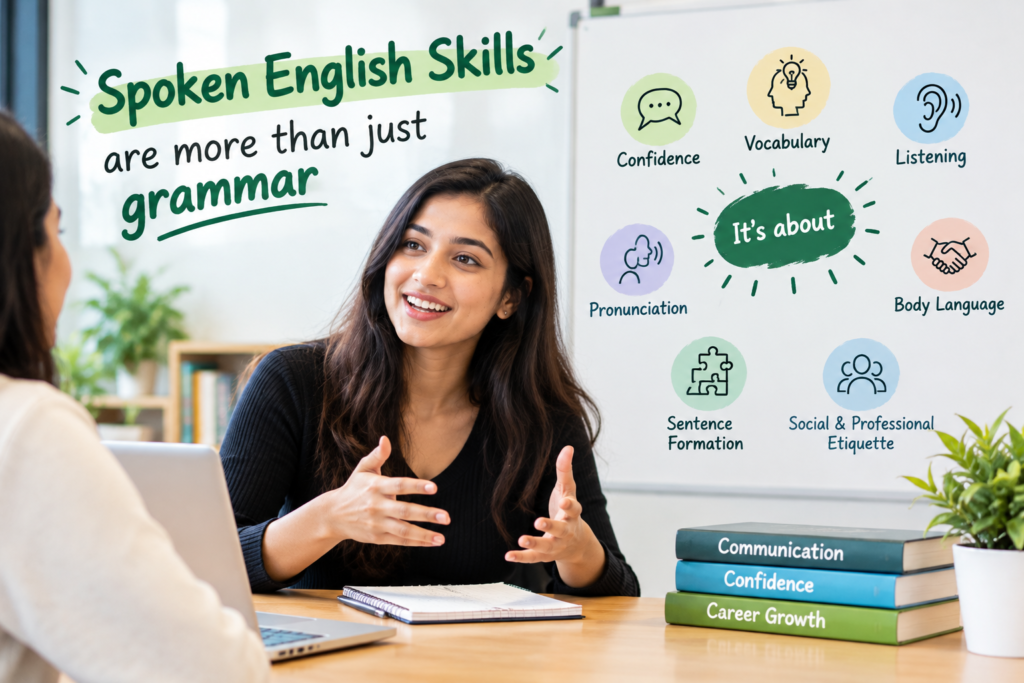
One common misconception is that good English speaking means knowing every grammar rule.
Grammar is certainly important. However, communication involves much more. Effective speaking includes confidence, pronunciation, vocabulary, listening, body language, sentence formation and the ability to respond appropriately. For example, someone may know advanced grammar but still hesitate during a simple conversation.
Another person may use simple sentences but communicate their thoughts clearly and confidently. Therefore, while grammar should be improved, practical speaking practice should also be a major part of your learning journey.
How GILP Can Help You Build Spoken English Skills

At GILP – Global Institute for Language & Personality, English learning is focused on practical communication and confidence building.
Instead of treating English as only a theoretical subject, learners can work on speaking, communication and personality development through practical activities and guided learning. Whether your goal is to speak English more confidently, prepare for interviews, improve workplace communication or develop your overall personality, structured learning can give you the guidance and regular practice you need.
GILP also offers learning support for areas such as Spoken English, Personality Development, Public Speaking, IELTS, PTE and Interview Preparation. The right course, combined with consistent practice, can help you move from hesitation towards more confident communication.
Who Should Improve Their Spoken English Skills?
Improving Spoken English Skills can benefit people at different stages of their careers.
It can be useful for:
- Students preparing for college or job opportunities
- Freshers preparing for interviews
- Working professionals aiming for career growth
- Job seekers preparing for interviews
- Professionals working with clients
- People preparing for IELTS or PTE
- Individuals who feel nervous while speaking English
- Anyone who wants to communicate more confidently
In short, you do not need to wait for a specific career stage to improve your English. The earlier you start, the more opportunities you have to practise.
Final Thoughts
Your career is built on more than a degree or qualification. Knowledge, technical abilities, confidence and communication all contribute to professional growth. That is why Spoken English Skills can be a valuable addition to your career toolkit.
From performing better in interviews to participating confidently in meetings, communicating with colleagues and presenting your ideas, better English speaking ability can support you in many professional situations.
However, improvement does not happen overnight. Start with small conversations. Practise every day. Learn useful vocabulary. Listen carefully. Speak without being afraid of mistakes. Most importantly, stay consistent. With the right guidance and regular practice, you can gradually become a more confident English speaker.
Ready to improve your Spoken English Skills and communicate with greater confidence? Start your learning journey with GILP and take the next step towards stronger communication and better career opportunities.