
Introduction
Table of Contents
TogglePreparing for IELTS requires a clear understanding of the test format, regular practice, and a balanced approach to all four skills. The IELTS test evaluates Listening, Reading, Writing and Speaking, with different requirements for Academic and General Training in the Reading and Writing sections. Listening and Speaking are the same in both test types. Whether you are preparing for higher education, professional requirements, or migration, a structured IELTS exam preparation plan can help you understand the question types, manage your time, and identify areas that need more practice.
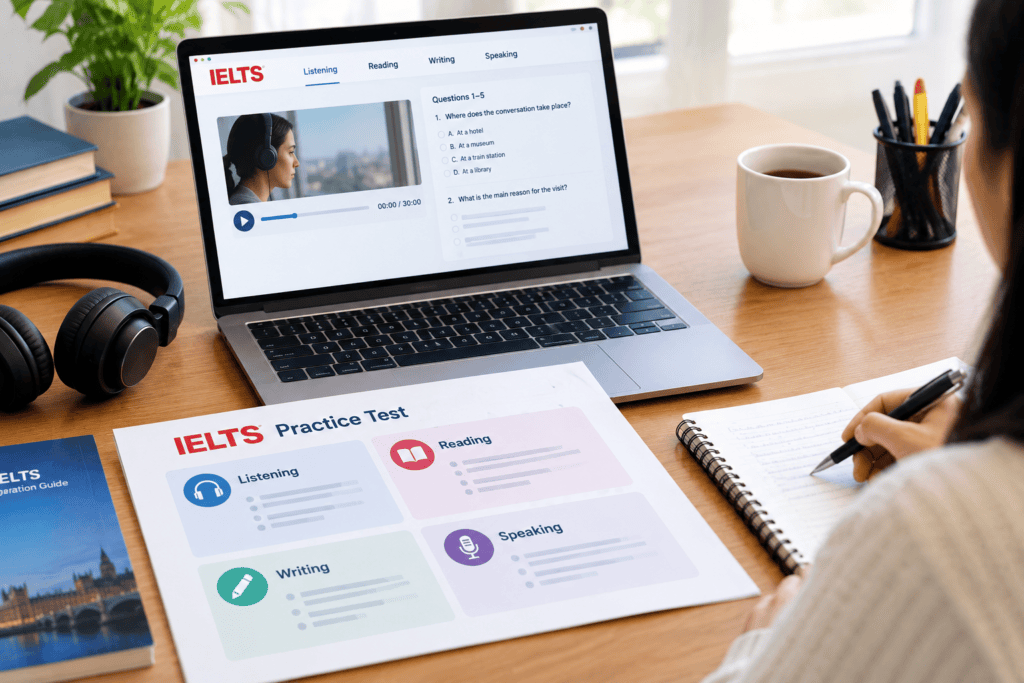
Official IELTS resources also provide sample questions, practice tests and other preparation materials to help candidates become familiar with the test.
Understand the IELTS Test Format
Before beginning your preparation, understand what each section involves.
IELTS has four sections:
- Listening
- Reading
- Writing
- Speaking
Listening takes approximately 30 minutes, Reading and Writing each take 60 minutes, while Speaking lasts around 11–14 minutes.
Understanding the format allows you to practise according to the actual requirements instead of simply studying English without a clear test strategy.
IELTS Listening Preparation
The listening test has four parts with 40 questions. You hear each recording once, and the test can include different accents. Question types may include multiple choice, matching, form completion, note completion, sentence completion, and short-answer questions.

For effective Listening preparation:
- Read the questions before the recording starts.
- Focus on keywords and important details.
- Practise listening for names, numbers, dates and places.
- Pay attention to spelling.
- Follow the word limit given in the instructions.
- Practise with different question types.
- Review your incorrect answers after every test.
Regular listening practice can also help you become more comfortable with different accents and speaking styles.
IELTS Reading Preparation
The Reading section requires you to understand written information, locate details and identify the meaning of passages within a limited time. IELTS Academic Reading contains three parts and 40 questions.

During your Reading preparation, practise:
- Skimming passages to understand the main idea.
- Scanning for specific information.
- Identifying keywords and synonyms.
- Understanding paraphrased information.
- Managing time across different passages.
- Practicing multiple question types.
- Avoiding spending too much time on one question.
Improving your reading speed is useful, but accuracy should remain equally important. Always review mistakes and understand why an answer was incorrect.
IELTS Writing Preparation
Writing requires you to organise your ideas clearly and respond directly to the task. In IELTS Academic Writing, Task 1 involves describing visual information such as a graph, table, chart or diagram, while Task 2 requires an essay responding to a point of view, argument or problem.

For better Writing preparation:
- Understand the question before you begin.
- Spend a few minutes planning your response.
- Organise your ideas into clear paragraphs.
- Use examples and explanations where appropriate.
- Avoid memorising complete essays.
- Check grammar, spelling and punctuation.
- Practise within the actual time limit.
Task 2 requires a minimum of 250 words and carries more weight than Task 1 in the writing score, so learners should give sufficient attention to both tasks while practicing.
IELTS Speaking Preparation
The Speaking test lasts approximately 11–14 minutes and consists of three parts. It includes questions about familiar topics, an individual long turn and a discussion involving broader ideas.

To improve your speaking skills:
- Practice speaking English regularly.
- Record yourself answering practice questions.
- Avoid memorising fixed answers.
- Give complete and relevant responses.
- Develop your vocabulary through regular reading and conversation.
- Work on pronunciation and clarity.
- Practice expressing opinions and explaining your ideas.
The objective is not simply to speak more but to communicate your ideas clearly and appropriately.
Create a Practical IELTS Study Plan
A good study routine should give attention to all four IELTS sections. Instead of spending several days only on vocabulary or grammar, divide your preparation time between Listening, Reading, Writing and Speaking.
You can also include regular mock tests to understand your progress and identify recurring mistakes. Official IELTS sample materials can help you become familiar with question types, practise under timed conditions and review your answers.
Keep a simple record of your mistakes. For example, if you repeatedly lose marks because of spelling in Listening or struggle with time management in Reading, make those areas part of your next practice session.
Common Mistakes During IELTS Exam Preparation
Some common preparation mistakes include:
Preparing without understanding the test format
Learn the structure before starting full-length practice.
Ignoring time management
Practise completing each section within the available time.
Memorising Speaking answers
Prepare ideas and vocabulary, but practise responding naturally.
Focusing only on vocabulary
IELTS assesses four different language skills, so preparation should be balanced.
Not reviewing mistakes
Completing practice tests is less useful if you never analyse your errors.
Why Choose GILP for IELTS Preparation?
Choosing the right learning environment can make your preparation more organized and consistent. GILP provides IELTS training focused on the four core skills—Listening, Reading, Writing and Speaking.
Practical Section-Wise Preparation
Learners can work separately on the skills required for each IELTS section, helping them understand different question types and task requirements.
Regular Practice
Consistent practice can help learners become more familiar with IELTS-style questions and improve their ability to work within time limits.
Speaking and Communication Practice
Speaking practice gives learners opportunities to develop fluency, vocabulary, pronunciation, and confidence while responding to different topics.
Writing Guidance
Learners can practise IELTS Writing tasks while focusing on organisation, relevance, vocabulary, grammar, and clarity.
Mock Tests and Performance Review
Practice tests can help learners understand their current performance and identify areas that require additional attention.
Support for IELTS Learners in Delhi
For students searching for IELTS preparation in Delhi, IELTS coaching in Janakpuri, or IELTS classes in Delhi, GILP offers a structured learning environment focused on regular practice and IELTS-related skills.
The Importance of Regular Mock Tests
Mock tests can help you become familiar with the pressure of completing IELTS tasks within a limited amount of time. They also provide an opportunity to identify recurring mistakes and understand which areas need additional practice.
After completing a mock test, don’t only look at the final score. Review the questions you answered incorrectly and identify the reason behind each mistake. This could be a vocabulary issue, misunderstanding of the question, spelling error, lack of time, or difficulty organizing your response.
Keeping a simple progress record can make your preparation more organized and help you see which areas are improving and which still require attention.
Frequently Asked Questions
GILP focuses on structured IELTS preparation across Listening, Reading, Writing and Speaking. Learners can work on English communication skills through regular practice and guided learning. GILP’s broader language and personality training also focuses on communication, confidence and practical English skills.
Start by understanding the IELTS test format and identifying your strengths and weaker areas. Create a study schedule that gives regular time to Listening, Reading, Writing and Speaking. Practice with IELTS-style questions and review your mistakes regularly.
The preparation time depends on your current English level, target band score, available study time, and the areas that require improvement. Taking a practice test at the beginning can help you understand your current level and plan your preparation accordingly.
Yes. Listening and Speaking are the same in both tests, while Reading and Writing have different formats and requirements.
Regular speaking practice can help you become more comfortable expressing your ideas. Practise answering different topics, record your responses, work on pronunciation and vocabulary, and focus on giving clear and developed answers instead of memorising complete responses.
Practise both Writing tasks regularly. Understand what each question requires, plan your ideas before writing, organise your response into clear paragraphs and review your grammar, vocabulary, spelling and overall coherence.
Practise with IELTS-style recordings and different English accents. Read the questions before listening, identify important information, and carefully review incorrect answers after each practice session.
GILP can support your IELTS preparation by helping you practise the four core language skills in a structured learning environment. You can work on areas such as English fluency, communication, vocabulary, speaking and written expression while preparing for IELTS-related tasks. GILP’s language-focused training also emphasises practical communication and confidence-building.
Final Thoughts
Effective IELTS exam preparation requires consistency rather than last-minute study. Give balanced attention to Listening, Reading, Writing and Speaking, practise different question types, complete timed tests and regularly review your mistakes.
A structured preparation routine can help you approach the IELTS test with a clearer understanding of what each section requires. If you are preparing in Delhi and prefer guided learning, explore GILP’s IELTS training for structured practice across the four IELTS skills.