
Introduction:
Table of Contents
Toggle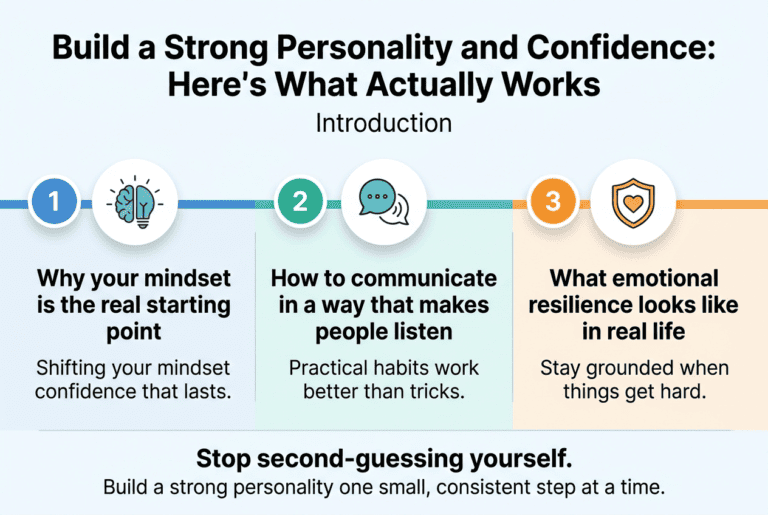
Most people don’t lack talent or intelligence—they lack the confidence to be themselves. If you’ve ever wondered how to make strong personality, held back in conversations, doubted your decisions, or felt like others seem more confident, this guide is for you. It will help you build confidence, improve communication, and develop a stronger, more authentic personality.
This is written for anyone who wants to stop second-guessing themselves and start building the kind of personality that commands respect without faking it.
Here’s what we’ll cover:
Why your mindset is the real starting point — and how shifting it creates confidence that actually lasts
How to communicate in a way that makes people listen — no tricks, just practical habits that work
What emotional resilience looks like in real life — and how to stay grounded when things get hard
By the end, you’ll have a clear, actionable path to building a strong personality — one small, consistent step at a time.
Define What a Strong Personality Really Means
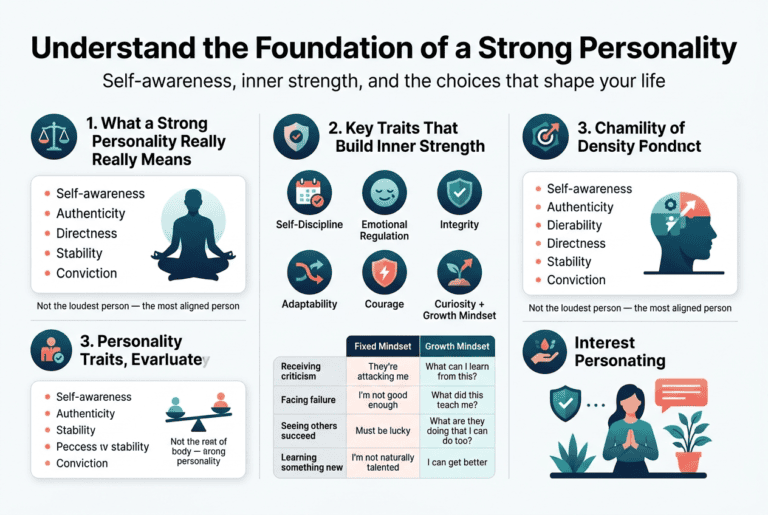
A strong personality is not about being the loudest person in the room or the one who dominates every conversation. It is something much deeper and more personal than that. At its core, a strong personality is about knowing who you are, standing by your values even when things get uncomfortable, and showing up as yourself — consistently — regardless of who is watching.
Think of it this way: a person with a strong personality does not need external validation to feel good about their choices. They have a clear internal compass. They know their boundaries, they know their strengths, and they are honest enough with themselves to acknowledge their weaknesses without spiraling into self-doubt.
Here is how to make strong personality in real life:
Self-awareness — You know your triggers, your patterns, and why you react the way you do.
Authenticity — You do not wear different masks for different people. You are the same person at work, at home, and with strangers.
Directness — You say what you mean without being harsh or cruel.
Stability — You do not fall apart every time life throws something unexpected at you.
Conviction — You hold firm to your beliefs while staying genuinely open to new information.
A strong personality is not something you are born with — it is something you build, day after day, through intentional choices and self-reflection. The good news is that no matter where you are starting from, you can develop it.
Identify the Key Traits That Build Inner Strength
Inner strength is the invisible backbone of a strong personality. If you’re wondering how to make a strong personality, it starts with developing the resilience to stay steady when everything around you feels chaotic. While some people may appear naturally confident, the truth is that confidence, resilience, and character are built through deliberate habits and consistent mindset shifts practiced over time.
Here are the key traits that consistently show up in people with real inner strength:
1. Self-Discipline
Self-discipline is the ability to do what needs to be done, even when you do not feel like doing it. It is waking up and honoring your commitments to yourself — your workout, your goals, your routines — even on the days you feel unmotivated. People with inner strength know that feelings are temporary, but actions have lasting consequences.
2. Emotional Regulation
This is not about suppressing your emotions. It is about being able to feel them without being controlled by them. People who have built this trait pause before they react, process what they are feeling, and respond in a way they are actually proud of afterward.
3. Integrity
Doing the right thing when no one is watching — that is integrity. It builds a deeply rooted sense of self-respect that no one can take away from you. Over time, consistent integrity makes you someone you genuinely trust and admire.
4. Adaptability
Strong people are not rigid. They can shift, adjust, and find new paths when the original plan falls apart. Life rarely goes exactly the way we expect, and adaptability is the trait that keeps you moving forward instead of getting stuck.
5. Courage
Not the absence of fear — but the ability to act despite it. Whether it is speaking up in a meeting, setting a difficult boundary, or starting over after a failure, courage is a daily practice.
6. Curiosity and a Growth Mindset
People with strong personalities are hungry to learn. They do not see failure as a permanent label — they see it as information. This mindset keeps them growing long after others have settled into comfort zones.
Here is a quick breakdown comparing a fixed mindset to a growth mindset approach:
Situation | Fixed Mindset Response | Growth Mindset Response |
|---|---|---|
Receiving criticism | “They’re attacking me” | “What can I learn from this?” |
Facing failure | “I’m just not good enough” | “What did this teach me?” |
Seeing others succeed | “Must be lucky” | “What are they doing that I can do too?” |
Learning something new | “I’m not naturally talented” | “I can get better with practice” |
Facing a challenge | “I should avoid this” | “This is a chance to grow” |
Building these traits does not happen overnight, but every small choice you make in the direction of discipline, honesty, and growth is a deposit into your inner strength account.
Your personality is more than a description of who you are—it is a blueprint for the life you will build. If you’re wondering how to make a strong personality, start by understanding that the way you think, communicate, handle adversity, and relate to others shapes the quality of your relationships, influences your career, and even affects your physical and mental well-being over time.
Research in psychology has consistently shown that personality traits like conscientiousness, emotional stability, and openness are strong predictors of life satisfaction and professional achievement. But you do not need a research paper to see this playing out. Just look around you.
How personality influences your relationships:
- If you struggle with vulnerability, you will find it hard to build deep, trusting relationships.
- Having poor emotional regulation? conflicts will tend to escalate rather than resolve.
- If you lack self-worth, you may tolerate treatment that you should not, or push away people who genuinely care about you.
How personality influences your career:
- A person who communicates clearly and confidently gets heard in meetings, earns respect, and advances faster.
- Someone who handles pressure well becomes the go-to person when stakes are high.
- A person with integrity builds a reputation that opens doors over years and decades.
How personality influences your daily experience:
- Your internal narrative — the story you tell yourself about who you are and what you deserve — shapes every decision you make, often without you even realizing it.
- People with a strong, grounded identity tend to make choices aligned with their values, which leads to a much deeper sense of fulfillment.
- Those who lack a strong sense of self often feel pulled in different directions by other people’s expectations, which creates chronic stress and confusion.
Here is a simple but powerful way to see the connection:
Personality Trait | Likely Life Outcome |
|---|---|
High self-discipline | Greater achievement and goal completion |
Strong emotional resilience | Better mental health and relationship stability |
Clear communication | Stronger career advancement and deeper connections |
Authentic self-expression | Higher self-respect and more genuine relationships |
Growth-oriented mindset | Continuous improvement and adaptability |
Low self-awareness | Repeated mistakes, unresolved patterns |
People-pleasing behavior | Resentment, burnout, loss of identity |
The personality you carry into every room either opens doors or closes them — and most of the time, you are not even aware it is happening. That is exactly why understanding and actively shaping your personality is one of the highest-leverage things you can ever do for your life.
Overcome Self-Doubt and Negative Thinking Patterns
Self-doubt is one of the biggest obstacles to building confidence and learning how to make a strong personality. It often disguises itself as “realistic thinking” when it’s actually fear holding you back. The good news is that you can recognize these negative thoughts, challenge them, and gradually retrain your mind to replace self-doubt with confidence and a stronger, more positive mindset.
The first step is becoming aware of your inner critic. Most people run on autopilot, never questioning the negative thoughts that pop up throughout the day. Start paying attention to what you’re telling yourself, especially in moments of challenge or discomfort. Are you saying things like “I’m not good enough” or “I’ll probably mess this up”? Those aren’t facts — they’re old stories your brain has been repeating for years.
Practical ways to break the cycle of negative thinking:
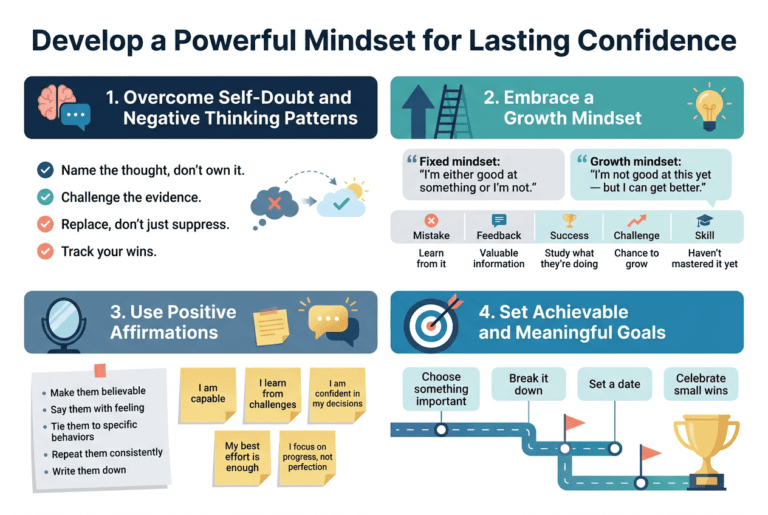
Name the thought, don’t own it. When a negative thought shows up, say to yourself, “There’s that thought again.” This creates distance between you and the narrative.
Challenge the evidence. Ask yourself: “Is this thought actually true? What proof do I have?” Most of the time, the fear doesn’t hold up under scrutiny.
Replace, don’t just suppress. Trying to push a negative thought away usually backfires. Instead, consciously replace it with a more realistic and empowering alternative.
Track your wins. Keep a simple journal where you jot down small daily wins. Over time, this builds a mental library of proof that you’re capable.
The goal here isn’t to walk around pretending everything is perfect. It’s about being honest with yourself while refusing to let worst-case-scenario thinking run the show.
Embrace a Growth Mindset to Fuel Personal Progress
Psychologist Carol Dweck spent decades researching why some people thrive in the face of challenges while others shut down. Her conclusion? It comes down to mindset. Specifically, whether you believe your abilities are fixed or whether you believe they can grow.
Fixed mindset says: “I’m either good at something or I’m not.”
Growth mindset says: “I’m not good at this yet — but I can get better.”
That one tiny word — yet — changes everything. It turns a dead end into a detour.
When you operate from a growth mindset, failure stops being a verdict on your worth and starts being data. Every mistake tells you something useful. Every setback gives you a chance to adapt. This is how genuinely confident people think — not because they never fail, but because they’ve stopped treating failure as a reason to quit.
Here's how the two mindsets compare in real-life situations:
Situation | Fixed Mindset Response | Growth Mindset Response |
|---|---|---|
Making a mistake at work | “I’m terrible at this job.” | “What can I learn from this?” |
Getting critical feedback | “They just don’t like me.” | “This is valuable information.” |
Seeing someone succeed | “They’re naturally talented.” | “I can study what they’re doing.” |
Facing a new challenge | “What if I fail?” | “This is a chance to grow.” |
Struggling with a skill | “I’m just not wired for this.” | “I haven’t mastered it yet.” |
Moreover, shifting to a growth mindset doesn’t happen overnight. Instead, it’s a daily practice of catching yourself in fixed thinking and consciously choosing a different perspective. For example, the next time something feels hard, remind yourself that difficulty is simply part of the learning process rather than a sign that you’re in the wrong place. Over time, this small shift in thinking can build greater resilience, confidence, and personal growth.
Use Positive Affirmations to Rewire Your Inner Voice
Positive affirmations sometimes get a bad reputation because they’re often used unrealistically. Simply standing in front of a mirror and repeating, “I am a millionaire,” without believing it is unlikely to create lasting change. However, affirmations that are realistic, believable, and emotionally meaningful can help reshape your mindset over time.
Moreover, your brain has a built-in filtering system called the Reticular Activating System (RAS). It acts like a spotlight, directing your attention toward experiences that reinforce your existing beliefs. For instance, if you believe you’re bad at socializing, your brain is more likely to notice awkward moments while overlooking successful interactions. As a result, using positive affirmations consistently and realistically can gradually shift what your brain focuses on, helping you build confidence and develop a more positive outlook.
How to use affirmations the right way:
- Make your affirmations believable. Instead of saying, “I am completely fearless,” try, “I am learning to act despite fear.” This feels more realistic, making it easier for your brain to accept and reinforce.
- Say them with genuine emotion. Simply repeating words isn’t enough. Instead, try to feel the confidence, calmness, or determination you’re describing, as emotion makes affirmations more meaningful.
- Connect them to specific behaviors. For example, saying, “I am someone who speaks confidently in meetings,” is far more effective than the general statement, “I am confident.” Specific affirmations encourage real actions.
- Repeat them consistently. Ideally, practice your affirmations every morning and before going to bed. Over time, this consistency helps reinforce positive beliefs and strengthens your mindset.
- Write them down. Physically writing your affirmations can make them more memorable and impactful. Therefore, keep them in a notebook, journal, or on sticky notes where you’ll see them every day.a
Examples of effective confidence-building affirmations:
“I am becoming more confident every day through the actions I take.”
“I handle challenges with calm and clarity.”
“My voice matters and I deserve to be heard.”
“I trust myself to figure things out.”
“I am worthy of success and good relationships.”
Over time, these statements stop being things you’re trying to convince yourself of and start becoming your default self-perception. That’s when real confidence takes root.
Set Clear Goals to Build a Sense of Purpose and Direction
Nothing erodes confidence faster than drifting through life without direction. When you wake up each day without a clear sense of where you’re headed, it’s easy to feel stuck, uncertain, and unmotivated. However, setting meaningful goals can completely change that. When you have something that genuinely excites you, you naturally become more focused and confident. As a result, you stand taller, make decisions with greater clarity, and spend far less time second-guessing yourself.
Goals give you a story to live inside — and the main character of that story is someone moving forward with intention.
The key elements of confidence-building goals:
- Clarity matters. Vague goals lead to vague results. For example, saying “I want to be healthier” is much harder to act on than saying, “I’ll work out three times a week and avoid soft drinks for the next 30 days.” The more specific your goal, the easier it is to stay focused.
- Take ownership of your goals. Your goals should reflect what you genuinely want, not what your parents, friends, or society expect from you. Otherwise, even achieving them may not give you a true sense of confidence or fulfillment.
- Choose goals that challenge you. Goals that are too easy won’t help you grow, while goals that are too unrealistic can feel discouraging. Instead, aim for goals that push you outside your comfort zone while remaining achievable through consistent effort.
- Track visible progress. Break large goals into smaller milestones and celebrate each achievement along the way. As a result, every small success builds momentum, strengthens your self-belief, and keeps you motivated to continue.
A simple goal-setting framework to get started:
Level | Timeframe | Example |
|---|---|---|
Micro Goal | Daily | Spend 20 minutes learning a new skill |
Short-Term Goal | 30–90 days | Complete an online course in public speaking |
Medium-Term Goal | 6–12 months | Land a leadership role or start a side project |
Long-Term Goal | 1–5 years | Build a business, write a book, or master a craft |
Review your goals regularly — weekly check-ins work well for most people. This keeps them front of mind and gives you the chance to adjust if life shifts. The point isn’t rigid adherence to a plan; it’s staying connected to the version of yourself you’re working toward.
When your daily actions align with your bigger vision, confidence stops being something you have to manufacture. It becomes a natural byproduct of living on purpose.
Speak With Clarity and Conviction in Every Situation
The way you speak tells others a lot about how you see yourself. For example, when you mumble, rush through your words, or trail off at the end of sentences, people may unconsciously assume you’re uncertain—even if you know exactly what you’re talking about. As a result, the way you communicate can influence how others perceive your confidence.
However, speaking with clarity and conviction doesn’t mean being loud or aggressive. Instead, it means choosing your words carefully, expressing your thoughts with confidence, and avoiding unnecessary filler words. Over time, practicing clear communication helps you build credibility, strengthen your presence, and develop a more confident personality.
Here are some practical ways to sharpen how you communicate:
Slow down your pace. Most people speak too fast when they’re nervous. Taking a beat before you respond shows confidence and gives you time to think clearly.
Drop the filler words. Words like “um,” “like,” “you know,” and “kind of” weaken your message. Practice pausing instead of filling silence with noise.
Be direct. Say what you mean without over-explaining or apologizing for your opinion. “I think we should do X” lands much stronger than “I’m not sure, but maybe we could possibly try X?”
Use concrete language. Vague statements make you sound wishy-washy. Specific, clear statements make you sound credible.
Vary your tone. A flat, monotone voice makes even the best ideas sound boring. Rise and fall naturally to keep people engaged.
Make eye contact. When you look someone in the eye while you speak, it communicates that you believe what you’re saying.
One exercise that works incredibly well: record yourself speaking for two minutes on any topic. Watch it back. You’ll immediately notice patterns you didn’t realize were there — and that awareness alone pushes you to improve.
The Power of a Strategic Pause
Silence is one of the most underrated communication tools. In fact, a deliberate pause before answering a question shows that you’re thoughtful rather than reactive. It also signals to the other person that your response is worth waiting for. As a result, your words often carry more weight and confidence.
Similarly, leaders, great speakers, and respected communicators rarely feel the need to fill every moment with conversation. Instead, they use pauses intentionally to gather their thoughts, speak with clarity, and make a stronger impact. Over time, becoming comfortable with silence can improve your communication skills and strengthen your personality.
Use Body Language to Strengthen Your Personal Presence
You can say all the right things and still undermine your message with poor body language. In fact, research consistently shows that nonverbal communication plays a major role in how others perceive you. People are constantly interpreting your posture, gestures, facial expressions, and movements, whether you realize it or not.
Therefore, improving your body language is just as important as choosing the right words. Standing tall, maintaining eye contact, using open gestures, and smiling naturally can make you appear more confident, approachable, and trustworthy. Over time, these small changes can strengthen both your communication skills and your overall personality.
The good news? You can train your body language just like you train any other skill.
Posture and Space
- Stand tall. Keep your shoulders relaxed and slightly back, your chest open, and your head level. As a result, you not only appear more confident to others but also begin to feel more confident yourself.
- Take up appropriate space. Instead of crossing your arms, looking at the floor, or trying to make yourself seem smaller, maintain an open and balanced posture. This naturally communicates confidence and shows that you belong in the room.
- Plant your feet firmly. Avoid swaying, rocking, or constantly shifting your weight, as these habits can signal nervousness. Instead, stand with your feet about shoulder-width apart and stay grounded. Over time, this simple adjustment helps you project greater confidence and presence.
Gestures and Facial Expressions
- Use open hand gestures. For example, keeping your palms visible makes you appear more trustworthy, confident, and engaged. In contrast, pointing fingers or crossing your arms can make you seem defensive or unapproachable.
- Smile genuinely. A genuine smile reaches your eyes and creates a positive first impression. Since people can usually tell the difference between a real smile and a forced one, let your expressions reflect how you truly feel.
- Mirror the other person’s energy. Subtly matching someone’s posture, tone, or pace helps build rapport naturally. However, keep it subtle and authentic. Over time, becoming more aware of this habit can strengthen your communication skills and help you connect with others more effectively.
Eye Contact Done Right
Situation | Best Practice |
|---|---|
One-on-one conversation | Maintain eye contact 60–70% of the time |
Group speaking | Shift eye contact naturally across the group |
Listening | Increase eye contact to show full attention |
Emotional conversations | Steady, soft eye contact — not a stare |
Too little eye contact reads as evasive or uninterested. Too much becomes intense and uncomfortable. The sweet spot is natural, warm, and engaged.
Movement and Entry
The way you walk into a room sets the tone before you even say a word. Therefore, walk with purpose—neither rushed nor hesitant. Your entrance often communicates your confidence long before a conversation begins. As a result, people naturally form impressions based on the way you carry yourself.
Moreover, confident body language doesn’t require being the loudest person in the room. Instead, it comes from maintaining good posture, walking at a steady pace, and being comfortable with your presence. Over time, these small habits can make you appear more self-assured and leave a stronger first impression.
Listen Actively to Build Deeper and More Meaningful Connections
Here’s something many people don’t expect: becoming a great listener is one of the most effective ways to build confidence. When you genuinely listen instead of simply waiting for your turn to speak, you come across as secure, thoughtful, and sincerely interested in others. As a result, people are more likely to trust and respect you.
Moreover, good listeners tend to build stronger relationships because they make others feel heard and understood. Rather than trying to dominate every conversation, focus on asking meaningful questions, maintaining eye contact, and responding thoughtfully. Over time, this habit enhances your communication skills, strengthens your presence, and helps you develop a more confident personality.
Active listening goes way beyond just being quiet while someone else speaks. It’s a full-engagement practice.
What Active Listening Actually Looks Like
- Put your phone away completely—not face-down on the table, but out of sight. After all, divided attention is easy to notice and can make the other person feel unimportant.
- Make the other person feel heard. For example, nod occasionally, lean in slightly, and use simple verbal cues like “I understand,” “That makes sense,” or “Tell me more.” These small responses show that you’re actively listening.
- Avoid interrupting or rushing to offer solutions. Instead, let the other person finish speaking. In many situations, people want to feel understood before they want advice.
- Ask thoughtful follow-up questions. For instance, questions like “What happened next?” or “How did that make you feel?” show that you’re genuinely engaged in the conversation.
- Finally, reflect back what you’ve heard. Saying something like, “So, if I understand correctly, you’re saying…” confirms that you were paying attention and gives the other person an opportunity to clarify or expand their thoughts.
Why Listening Builds Your Confidence
When you become a strong listener, several positive changes begin to happen:
- You learn more. Every conversation becomes an opportunity to gain new insights. As a result, your knowledge and perspective continue to grow over time.
- People trust you more. Since trust is built through genuine listening, people naturally feel more comfortable opening up to you. Consequently, this strengthens your relationships and boosts your self-confidence.
- You become comfortable with silence. Instead of feeling pressured to fill every pause, you learn that silence is a natural part of meaningful conversations. Over time, this can significantly reduce social anxiety.
- You become more present. Rather than worrying about whether you’re saying the right thing or whether others like you, your attention shifts to understanding the other person. As a result, your mind becomes calmer, your conversations become more meaningful, and your confidence grows naturally.
The Listening vs. Hearing Distinction
Hearing | Active Listening |
|---|---|
Passive, automatic | Intentional and focused |
Retains little information | Retains key details and emotion |
Waiting to respond | Seeking to understand |
Self-focused | Other-focused |
Creates surface-level connection | Builds genuine trust and rapport |
Conclusion
Building a strong personality and lasting confidence doesn’t happen overnight. Instead, it begins with understanding who you are, developing the right mindset, improving your communication skills, and learning to stay calm when life becomes challenging. If you’ve been wondering how to make a strong personality, these habits work together to create meaningful and lasting change. As you practice them consistently, you’ll become more confident, resilient, and self-assured.
Most importantly, remember that confidence is built through action, not by waiting for the perfect moment. So, start with one small step, stay consistent, and keep becoming the person you want to be. After all, every positive habit you develop contributes to a stronger personality over time. Your future self will thank you for starting today.