
Introduction: How To Improve English
Table of Contents
ToggleMany English learners experience a frustrating situation: they know a word, they have used it before, and they understand its meaning—but the moment they need to speak, the word suddenly disappears. They pause, they search their memory, they feel nervous. Sometimes, they replace the sentence with a simpler one or avoid expressing the complete idea. This experience is extremely common among language learners. It often creates a belief that they do not know enough English or that their vocabulary is weak. However, forgetting words during conversations does not always mean a lack of knowledge. In many cases, the problem is not learning the word, but retrieving the word at the right moment. Understanding this challenge is an important step in learning how to improve English and speak with greater confidence.
Speaking a language requires the brain to perform several tasks at the same time: thinking of an idea, choosing words, forming sentences, maintaining confidence, and responding to another person. This is why a learner may remember a word while reading or writing but struggle to recall it during a real conversation. Understanding this process is the first step towards improving speaking confidence.
Knowing a Word and Using a Word Are Different Skills
One of the biggest misunderstandings about vocabulary learning is assuming that recognising a word means being able to use it naturally. In reality, understanding this difference is essential if you want to learn how to improve English and communicate more confidently in everyday conversations.
There are two types of vocabulary knowledge:
● Passive vocabulary: words a person understands when they hear or read them.
● Active vocabulary: words a person can recall and use while speaking or writing.
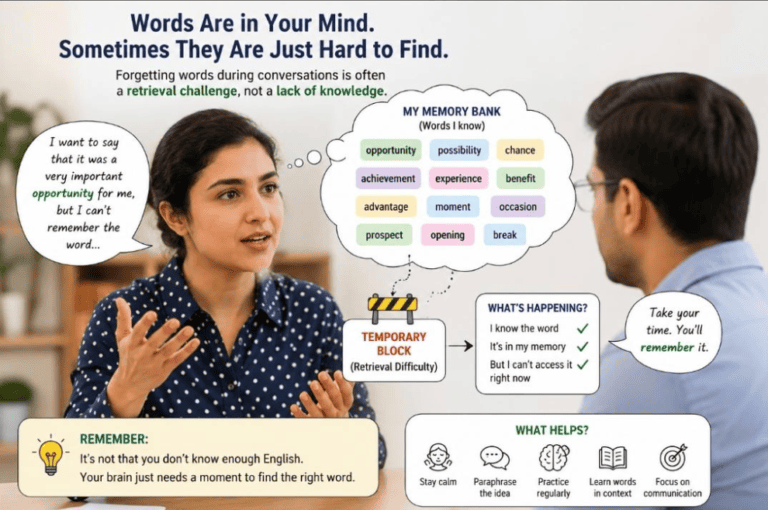
Many learners have a large passive vocabulary. They understand movies, articles, conversations, and books, but they struggle to bring those words into their own speech. For example, a learner may know the word “opportunity.”
They understand it when they hear:
“This is a great opportunity.”
But while speaking, they may pause and think:
“What was that word again?”
This happens because the brain needs regular practice to create a quick connection between a thought and a spoken word.
How To Improve English: Why Words Disappear During Conversations
There are several reasons why learners forget English words while speaking.
Pressure and Anxiety:
One of the biggest reasons is pressure.
When a person speaks in a real situation, the brain is not only searching for words. It is also managing emotions.
The learner may think:
“Am I speaking correctly?”
“Will others notice my mistake?”
“Am I sounding confident?”
This extra pressure affects natural recall. A word that was easily available during relaxed practice may become difficult to access during an interview, presentation, or conversation.
Translating From the First Language: Many learners think in their first language and then try to convert their thoughts into English. This creates an additional step. Instead of directly expressing an idea, the brain first searches for the meaning in one language and then searches for the English equivalent. This process can slow down speaking. The goal is not to stop thinking in one’s first language immediately, but gradually develop a direct connection between ideas and English expressions.
Lack of Speaking Practice:
Vocabulary grows stronger when it is used repeatedly. A learner may learn a word once and remember it for a short time, but if they never use it in conversations, the brain does not consider it a frequently needed word. Regular usage makes vocabulary more accessible.
Trying to Find the Perfect Word:
Many learners hesitate because they want to choose the exact, impressive word. They reject simple words while searching for advanced vocabulary. This interrupts the flow of communication. Effective speakers do not always use the most complicated words. They use words that communicate their message clearly.
The Difference Between Vocabulary Knowledge and Communication Ability
Communication is not a vocabulary competition. A person does not need thousands of difficult words to become a confident speaker. Professional communication depends on:
– clarity
– organisation of ideas
– confidence
– appropriate expression
For example, instead of searching for a complex word, a speaker can explain the idea differently.
If someone forgets “exhausted,” they can say:
“I am extremely tired.”
The message is still communicated.
A strong communicator knows how to keep the conversation moving.
How to Improve English Word Recall During Conversations
The solution is not simply memorising more vocabulary. It is training the brain to access existing vocabulary faster.
Learn Words in Context:
Learning isolated words is less effective. Instead of memorising: “confident = feeling sure”, learn it through situations: “She spoke confidently during the interview.” Context creates stronger memory connections.
Use New Words Immediately:
A new word becomes stronger when it is used. After learning a word, try to:
1. make sentences
2. speak using it
3. include it in conversations
4. connect it with personal experiences
Usage turns passive vocabulary into active vocabulary
Practise Speaking Without Stopping:
Many learners stop themselves after every sentence to check accuracy. This creates hesitation. A better method is to practise speaking continuously for a few minutes. The focus should be on expressing ideas first. Correction and improvement can happen afterwards.
Think in Ideas, Not Individual Words:
Good speakers do not mentally search for every single word. They focus on communicating an idea. Instead of thinking:
“What word should I use?”
think:
“What do I want to tell the listener?”
This reduces pressure and improves flow.
The Role of Confidence in Word Recall:
Confidence and vocabulary recall are connected. When people feel relaxed, they often remember words more easily. This is why someone may speak comfortably with friends but struggle in an interview. The knowledge exists, but pressure affects access to that knowledge. Building confidence through regular practice helps the brain retrieve language more naturally.
Why Reading Alone Is Not Enough:
Reading is an excellent way to improve vocabulary, but reading alone cannot create speaking fluency. A learner may read hundreds of words but still struggle to use them. Speaking requires active practice. Balanced approach includes:
1. reading
2. listening
3. speaking
4. writing
Each skill supports the others.
English Conversations and Real-Time Thinking:
Real conversations require quick thinking. Unlike written communication, speaking does not allow unlimited time to edit. This is why learners need practice with real situations:
1. answering questions
2. explaining opinions
3. describing experiences
4. participating in discussions
The more the brain experiences these situations, the easier recall becomes.
A Better Way to Approach Mistakes:
Many learners believe forgetting a word is a failure. However, it is actually valuable information. It shows which words need more practice and which situations create pressure. Therefore, improvement comes from noticing these patterns and working on them consistently. After all, language development is a gradual process.
Building a Stronger Speaking Habit:
Small daily habits can improve word recall significantly. Learners can:
1. speak for five minutes every day
2. describe daily activities in English
3. record their voice
4. practise common workplace situations
5. learn useful phrases instead of random words Consistency creates confidence.
Ready to Turn Passive Vocabulary Into Confident Speech?
Knowing the words isn’t the problem—accessing them in real conversations is. That’s why GILP‘s Spoken English program focuses on real-time speaking practice instead of rote memorisation. If you’re wondering how to improve English, consistent speaking practice is the key. As a result, you’ll build confidence, recall words more easily, and communicate naturally in everyday and professional situations.
Conclusion: The Bigger Picture
Forgetting English words during conversations is a common challenge, but it does not mean that a person is incapable of learning the language. Often, the words are already stored in the mind. The challenge is creating a faster connection between thoughts and speech. The journey towards better English speaking is not about collecting endless vocabulary. It is about developing the ability to use language naturally.
The goal is not just to know more words.
Goal is to communicate ideas with confidence.
FAQs:
This happens because recognising a word and recalling it while speaking are two different skills. While reading and listening don’t require quick retrieval, speaking does. Therefore, regular practice using words aloud helps convert passive vocabulary into active vocabulary.
Not necessarily. In most cases, the word is already stored in your memory. However, the real challenge is retrieving it quickly under pressure. Therefore, this is a retrieval issue rather than a knowledge gap.
Confidence and word recall are closely linked. In fact, relaxed situations reduce mental pressure, making it easier to access vocabulary. However, high-pressure situations like interviews increase anxiety, which can temporarily block word retrieval even for words you know well. Therefore, building confidence through regular speaking practice is just as important as learning new vocabulary.
Yes. When you think in your first language and then translate to English, it adds an extra mental step, which slows down speaking. However, with regular practice, you gradually form a direct connection between ideas and English expressions. As a result, you rely less on translation and speak more naturally.
Paraphrase. Instead of pausing to search for the exact word, express the same idea differently. For example, if you forget “exhausted,” you can say “I am extremely tired.” As a result, the conversation continues smoothly, and over time, this strategy helps build confidence and improve fluency.