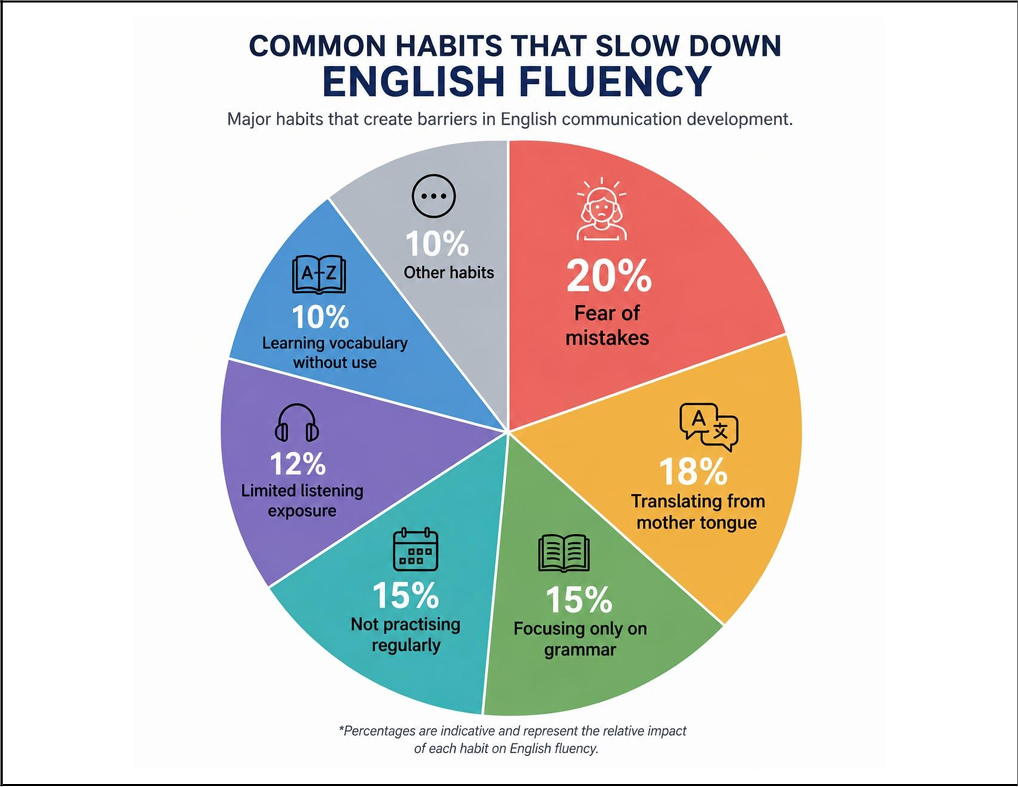
The Most Common Habits That Slow Down English Fluency

English fluency is often associated with vocabulary, grammar, and pronunciation. However, many learners overlook one crucial factor: their daily habits. If you want to know how to improve English fluency, changing these habits is just as important as learning new words. For example, a person may know hundreds of words and understand grammar but still hesitate while speaking. In most cases, the problem is not a lack of knowledge but habits that quietly create barriers to communication. Moreover, fluency does not develop overnight. Instead, it grows through consistent practice, regular exposure, confidence, and the right approach. Likewise, negative habits can gradually slow progress and make learners feel stuck even after months or years of study.

Let us explore some of the most common habits that affect English fluency and understand how learners can overcome them.

1. Waiting for Perfect English Before Speaking

One of the biggest obstacles to fluency is the habit of waiting until one’s English becomes “perfect” before using it. Many learners think:

“I will speak when my grammar becomes stronger.”
“First, I need to learn more vocabulary.”
“Only then will I start speaking without mistakes.”

However, fluency does not come before speaking; instead, it develops through regular speaking practice. If you are wondering how to improve English fluency, the answer begins with using the language consistently. For example, a child does not memorise grammar rules before communicating. Rather, the child experiments, makes mistakes, receives feedback, and gradually improves. Likewise, adults learn through the same process. Mistakes are not signs of failure; instead, they are valuable learning opportunities. Consequently, learners who speak English regularly usually improve faster than those who study silently and avoid communication. Ultimately, the goal is not to speak flawless English from day one but to express ideas clearly and confidently.

2. Translating Every Sentence from the Mother Tongue

Another common habit that slows down fluency is mentally translating everything before speaking. Many learners first create a sentence in their native language, translate it into English, and then speak. This process takes time and often creates hesitation. For example, instead of directly thinking:

“I am feeling tired today.”

A learner may first think in their mother tongue, translate each word, check grammar, and then speak. This habit makes conversations slow and uncomfortable. Fluent speakers do not usually translate every sentence. They develop the ability to think directly in English through regular exposure and practice. A better approach is to learn English in phrases and expressions rather than individual words. For example, instead of learning only the word “agree,” learn:

“I completely agree with you.”
“Partly, I agree with your point.”
“On the other hand, I don’t quite agree with that.”

These ready-to-use expressions help the brain produce English naturally.

3. Focusing Only on Grammar Rules

Grammar is important, but treating grammar as the entire language can limit fluency. Some learners spend years studying tenses, rules, and exceptions but still hesitate in real conversations. Why?

Because knowing a rule and using it automatically are two different things. For example, a learner may know the structure of the present perfect tense but still struggle to say:

“I have already finished my work.”

Fluency requires turning knowledge into a habit. Grammar should be learned as a tool for communication, not as a collection of rules to memorize. The best learners balance grammar study with listening, speaking, reading, and practical usage.

4. Learning Vocabulary Without Using It

Many learners collect new words but rarely use them in conversations. They memorize long vocabulary lists, understand meanings, and then forget the words because they never become part of their active language.

There is a difference between:

Passive vocabulary: Words you recognize when you hear or read them.
Active vocabulary: Words you can naturally use while speaking.

Fluency depends more on active vocabulary. Instead of learning fifty new words and using none, it is better to learn five useful words and create sentences with them. For example, after learning the word “resilient,” a learner can practice:

“She is a resilient person.”
“Resilience helps people overcome challenges.”

Using words repeatedly helps the brain store them for real communication.

5. Fear of Making Mistakes

Fear is one of the strongest barriers to language growth. Many learners avoid speaking because they worry:

“What will people think?”
“Could I pronounce something incorrectly?”
“Will someone laugh at me?”

This fear creates silence, and silence prevents improvement. However, language is a skill, and every skill improves through practice. If you want to know how to improve English fluency, accepting mistakes is an essential step. Even confident speakers sometimes make mistakes. Nevertheless, they do not allow those mistakes to stop them. Instead, they learn from them and continue speaking. As a result, learners who accept mistakes as feedback become more comfortable and improve faster.

Confidence does not come from being perfect. Confidence comes from repeated attempts.

6. Not Listening Enough

Many learners focus heavily on speaking but ignore the importance of listening. However, listening is the foundation of natural communication. Before speaking a language, we need to understand how people actually use it. Listening helps learners develop:

  1. natural sentence patterns
  2. pronunciation
  3. rhythm and tone
  4. common expressions
  5. conversational style

Textbook English and real-life English can sometimes be different. Regular exposure to English through conversations, podcasts, interviews, and videos helps learners understand how fluent speakers communicate. The more the brain hears English, the easier it becomes to produce English.

7. Practicing Only in the Classroom

A classroom provides guidance, structure, and correction. However, fluency cannot develop only inside the classroom. Instead, language learning requires regular contact with English. Therefore, a learner who attends English classes but never uses the language outside them may progress more slowly. Fortunately, small daily habits can make a big difference:

  1. speaking to yourself in English
  2. describing daily activities
  3. writing short thoughts
  4. listening to English content
  5. having conversations with others

Consistency matters more than occasional intense practice. Even fifteen minutes of daily practice can be more effective than studying once a week for several hours.

8. Comparing Yourself with Others

Every learner has a different journey. Some people speak confidently because they have had more exposure, different experiences, or more opportunities to practise. Constant comparison creates frustration and reduces motivation. Instead of asking:

“Why is my English not like theirs?”

Ask:

“Am I better than I was last month?”

Progress should be measured personally. Small improvements like speaking with less hesitation, learning new expressions, and understanding conversations better are signs of growth.

9. Using Very Limited Sentence Patterns

Many learners repeatedly use the same basic structures:

“I like…”
“Personally, I don’t like…”
“In my opinion, I think…”
“For now, I want…”

These sentences are useful, but relying only on them can limit communication. Fluent speakers use variety:

“From my perspective…”
“I strongly believe that…”
“One of the reasons is…”
“What I mean is…”

Learning different ways to express the same idea makes communication richer and more natural.

10. Neglecting Pronunciation and Intonation

Fluency is not only about words. It is also about how those words are delivered. Poor pronunciation habits can affect confidence and clarity. Learners should pay attention to:

  1. word stress
  2. sentence rhythm
  3. connected speech
  4. natural pauses

Good pronunciation does not mean copying a foreign accent. It means making speech clear and easy to understand.

11. Memorizing Answers Instead of Learning Communication Skills

Some learners prepare fixed answers for interviews, presentations, or conversations. While preparation is helpful, depending only on memorized responses creates problems when situations change. Real communication requires flexibility. Instead of memorizing complete answers, learners should develop skills like:

  1. organizing thoughts
  2. explaining opinions
  3. giving examples
  4. asking questions
  5. responding naturally

These skills make communication stronger in every situation.

12. Being Inconsistent

One of the most common reasons learners fail to become fluent is inconsistency. They practise for a few days, stop for weeks, restart again, and repeat the cycle. Language learning works through repetition. The brain needs regular exposure to build automatic responses. Fluency grows through small actions repeated consistently.

How to Improve English Fluency

Improve Your English Fluency with GILP

If you’re wondering how to improve English fluency, consistent speaking practice is the key. At GILP, our Spoken English program focuses on real conversations, confidence building, vocabulary development, and practical communication skills. Moreover, experienced trainers provide personalised guidance to help you overcome hesitation and speak naturally. Join GILP today and take the next step towards confident English communication for interviews, academics, and career success.

How to Build Better Fluency Habits

Replacing ineffective habits with productive ones can completely change the learning experience. Instead of waiting for perfection: Start speaking. Instead of translating every sentence: Think in simple English. Instead of only memorizing rules: Use the language practically. Instead of fearing mistakes: Learn from them.

Instead of translating every sentence, think in simple English.
Rather than memorising only rules, use the language in real situations.
Instead of fearing mistakes, learn from them.
Most importantly, create daily exposure instead of practising occasionally.

English fluency is not only a language goal; it is a communication skill that improves confidence, personality, and opportunities. Every learner has the ability to become a better English communicator with the right mindset and consistent practice. The journey towards fluency does not require becoming a different person. It requires developing better habits, one step at a time.

Remember: Fluent speakers are not people who never make mistakes; they are people who continue communicating despite them.

Improving English fluency requires consistent speaking practice, daily exposure to English, and regular conversations. Instead of memorising grammar rules alone, focus on using English in real-life situations to build confidence and fluency.

Common habits include translating from your native language, fearing mistakes, avoiding conversations, relying only on grammar, using limited vocabulary, and practising inconsistently. Replacing these habits with regular speaking practice improves fluency over time.

Grammar supports clear communication, but it does not create fluency by itself. To improve English fluency, learners should combine grammar with regular speaking, listening, and conversation practice.

Many learners develop passive knowledge through reading and listening but rarely practise speaking. As a result, they understand English well but find it difficult to communicate confidently.

The best Spoken English course in Delhi combines practical speaking sessions, experienced trainers, interactive classroom activities, and personalised feedback. It should focus on improving fluency, pronunciation, vocabulary, grammar, and communication skills through real-life conversations rather than theory alone. GILP offers a comprehensive Spoken English course in Delhi that helps students, professionals, and job seekers build confidence for interviews, academics, and workplace communication through structured, practice-oriented training.

The best Spoken English course in Janakpuri offers practical speaking sessions, experienced trainers, personalised feedback, and a curriculum focused on real-life communication. Learners should look for a course that improves fluency, pronunciation, vocabulary, grammar, and confidence through interactive activities and regular practice. GILP is a trusted choice in Janakpuri, providing industry-focused Spoken English training that helps students, professionals, and job seekers communicate confidently in academic, workplace, and everyday situations.