
Confidence isn’t a trait you are simply born with; instead, it is a skill you build over time. Many people believe that confident individuals never feel afraid or doubtful. However, the truth is quite different. True confidence is about acting despite fear, trusting your ability to figure things out, and recognizing your inherent worth. Therefore, if you want to build confidence, you must develop positive habits, embrace challenges, and learn from every experience. If you are looking to transform your self-belief, improve your presence, and unlock your full potential, this comprehensive guide will show you exactly how to build confidence step by step.
1. What Is Confidence?
Table of Contents
ToggleUnderstanding the Meaning of Confidence
At its core, confidence is a deep sense of trust in your own abilities, judgment, and qualities. In other words, it is the internal belief that you can handle the challenges life throws at you. However, confidence is not about knowing you will succeed flawlessly. Instead, it is about trusting that you will be okay even if you fail. Therefore, if you want to build confidence, you must learn to embrace challenges, accept setbacks, and believe in your ability to grow through every experience.
Confidence vs. Arrogance
It is crucial to distinguish between a healthy sense of self-belief and arrogance.
● Confidence is quiet, secure, and internally driven. A confident person doesn’t feel the need to prove anything to anyone. They lift others up because they do not feel threatened.
● Arrogance, on the other hand, is loud, fragile, and driven by insecurity. An arrogant person constantly seeks to validate their superiority by putting others down.
Why Confidence Matters
Confidence acts as the foundation for many of life’s choices. When you believe in yourself, you are far more likely to take risks, seize opportunities, and bounce back from setbacks. As a result, you become more willing to step outside your comfort zone and pursue meaningful goals. Moreover, confidence influences how you allow others to treat you and defines the boundaries you set for your personal and professional well-being. Therefore, if you want to build confidence, you must strengthen your self-belief through consistent actions, positive habits, and continuous personal growth.
2. Why Do People Lack Confidence?
Understanding where low self-esteem stems from is the first step toward overcoming it. It rarely happens overnight; instead, it is usually shaped by several key factors:
- Fear of Failure: The paralyzing dread of making a mistake can stop you from trying altogether, reinforcing the false belief that you aren’t capable.
- Negative Self-Talk: That harsh inner critic that constantly tells you “You aren’t good enough” or “You’ll ruin this” acts as a heavy anchor on your self-worth.
- Comparison with Others: Constantly measuring your behind-the-scenes life against everyone else’s polished, curated highlight reels—especially on social media—is a recipe for self-doubt.
- Past Experiences: Childhood criticism, a bad breakup, or a public failure can leave lingering emotional scars that make you hesitant to trust yourself again.
- Fear of Judgment: Being overly consumed by what other people think causes you to hide your true self to avoid criticism.
3. Signs of Low Confidence
Low confidence often masquerades as other personality traits, like perfectionism or being “easygoing.” Here are the classic signs to watch out for:
- Constant Self-Doubt: Second-guessing every decision you make, from what to wear to major career moves.
- Avoiding Opportunities: Turning down promotions, social invitations, or new projects because you assume you aren’t ready or qualified.
- Difficulty Making Decisions: Overanalyzing options and relying heavily on others to tell you what to do.
- Seeking Constant Approval: Needing perpetual validation from friends, family, or managers to feel secure in your worth.
- Fear of Speaking Up: Keeping your ideas, opinions, and feelings to yourself during meetings or conversations because you assume they don’t matter.
4. The Benefits of Building Confidence
When you commit to working on your self-belief, the rewards ripple across every single area of your life.
5. Change Your Mindset
Confidence is a mind game. To shift your external reality, you must rewrite your internal script.
Replace Negative Thoughts
Start catching your inner critic in the act. When a thought like “I can’t do this” pops up, actively pause and reframe it to: “This is challenging, but I have the skills to figure it out step-by-step.”
Practice Self-Compassion
Treat yourself with the same kindness and understanding you would offer a close friend. Whenever you make a mistake, avoid being overly critical of yourself. Instead, acknowledge the error, accept that imperfection is part of being human, and focus on what you can learn from the experience. As a result, you will gradually build confidence by replacing self-criticism with self-compassion and resilience.
Focus on Progress, Not Perfection
Perfection is an illusion that often leads to procrastination and unnecessary anxiety. Instead, focus on consistent progress rather than flawless results. After all, becoming just 1% better today than you were yesterday is a meaningful achievement. Moreover, every small improvement strengthens your skills and helps you build confidence over time. Therefore, celebrate your growth, stay patient with yourself, and remember that steady progress is far more valuable than chasing perfection.
Develop a Growth Mindset
Adopt the belief that your talents and intelligence can be developed through dedication, consistent effort, and hard work. Instead of viewing challenges as a test of your worth, see them as valuable opportunities to learn and expand your abilities. Moreover, embrace mistakes as part of the learning process rather than signs of failure. As a result, you will gradually build confidence by focusing on growth, resilience, and continuous improvement instead of seeking perfection.
6. Improve Your Body Language
Your body communicates with your brain just as much as your brain communicates with your body. By adopting confident physical postures, you actually trigger chemical changes that make you feel more secure.
- Stand Tall: Roll your shoulders back, pull your shoulder blades slightly together, and keep your chin up. Good posture instantly projects authority.
- Maintain Eye Contact: Looking people in the eye builds an immediate connection and shows that you are fully present and engaged.
- Smile Naturally: A warm smile puts both you and the person you are interacting with at ease.
- Use Confident Gestures: Avoid fidgeting, crossing your arms tightly, or touching your neck. Use open palm gestures to convey honesty and openness.
- Speak with Clarity: Slow down your speech rhythm. Take intentional pauses rather than rushing through your sentences or relying heavily on filler words like “um” or “like.”
7. Build Confidence Through Daily Habits
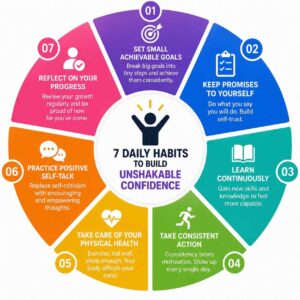
True self-esteem is forged in the fires of your daily routine. Small, consistent actions build an undeniable stack of proof that you are capable.
- Set Small Achievable Goals: Break big ambitions down into tiny, bite-sized daily tasks.
- Celebrate Small Wins: Give yourself credit for the little things, whether it’s clearing your inbox or showing up to the gym.
- Exercise Regularly: Physical movement releases endorphins, boosts your body image, and makes you feel strong and powerful.
- Eat Healthy and Sleep Well: Your physical vitality directly influences your emotional resilience. You cannot feel truly confident if your body is exhausted and running on poor fuel.
- Practice Gratitude: Spend a few minutes each day focusing on what is going right in your life rather than obsessing over what is missing.
8. Develop Strong Communication Skills
How you interact with the world heavily dictates how confident you feel within it.
- Become an Active Listener: Truly focus on what the other person is saying rather than just plotting your next response. When you listen deeply, your eventual replies are much more impactful.
- Improve Your Vocabulary: Read broadly and express yourself precisely. Clear language reflects a clear mind.
- Speak with Purpose: Eliminate minimizing phrases like “I just wanted to say” or “Sorry to bother you, but…” Own your words and say what you mean directly.
- Learn to Say “No”: Setting firm, polite boundaries protects your time and energy, signaling to yourself and others that your needs are valuable.
- Ask Thoughtful Questions: Shifting the spotlight onto others by asking engaging questions takes the pressure off you while making you look incredibly socially savvy.
9. Face Your Fears
The ultimate antidote to self-doubt is action. You cannot think your way into confidence; you have to act your way into it.
- Step Outside Your Comfort Zone: Do one thing every week that scares you slightly. The more you expand your boundaries, the smaller your fears become.
- Learn from Failures: When things don’t go as planned, conduct a mental post-mortem. Ask yourself: “What did this teach me?” and carry that wisdom into your next attempt.
- Take Calculated Risks: Stop waiting for a 100% guarantee of success. Weigh the pros and cons, prepare as best as you can, and then leap.
- Build Resilience: Understand that setbacks are a natural part of the journey. Every time you get back up after falling, your baseline confidence reaches a completely new level.
- The Takeaway: Building confidence is a lifelong journey of self-discovery, practice, and persistence. Start today by choosing just one small habit or mindset shift from this guide. Be patient with yourself, keep showing up, and watch your world transform.
10. Stop Comparing Yourself to Others
Comparison is the fastest way to kill your confidence. When you measure your internal struggles against someone else’s external highlights, you play a losing game.
- Focus on Your Own Journey: Your only real competition is the person you were yesterday. Keep a personal growth journal to track how far you’ve come over months and years.
- Limit Social Media Comparison: Social media platforms are heavily curated portfolios, not reality. Take regular digital detoxes or unfollow accounts that trigger feelings of inadequacy.
- Appreciate Your Strengths: Make a list of things you are genuinely good at—whether it’s strategic thinking, being an empathetic listener, or problem-solving. Own those talents completely.
11. Build Confidence in Different Areas of Life
Confidence isn’t always global; you can feel incredibly capable in one setting and totally out of your depth in another. The key is knowing how to adapt your self-belief across different environments:
Public speaking is a skill, not a genetic trait. Prepare thoroughly, speak slightly slower than your normal conversational pace, and treat the presentation as a conversation with the audience rather than a performance.
Confidence at School or College
In academic settings, confidence comes from active engagement. Participate in discussions, ask clarifying questions, and don’t be afraid to voice an analytical perspective, even if it differs from the norm.
Confidence at Work
Own your role. Document your wins, contributions, and successful projects throughout the year so you have hard evidence of your value when asking for a promotion or leading a new initiative.
Confidence in Social Situations
Shift the spotlight away from your own anxieties by focusing entirely on the people around you. Ask open-ended questions and practice active curiosity; people love being heard.
Confidence in Interviews
An interview is a two-way street—you are evaluating them just as much as they are evaluating you. Go in prepared with specific examples of how you’ve solved problems in the past, and remember your worth
Confidence in Leadership
Great leaders don’t have all the answers; they have the confidence to guide others toward finding them. Focus on empowering your team, making decisive choices, and taking accountability when things go sideways.
Just as building physical muscle requires regular exercise, building mental strength demands consistent, targeted practice. Therefore, if you want to build confidence, you must train your mind through practical exercises and positive habits. Rather than relying on motivation alone, incorporate the following confidence-building activities into your weekly routine. Over time, these small but consistent actions will strengthen your self-belief and help you face challenges with greater resilience.
13. Common Confidence Mistakes to Avoid
Sometimes, the biggest barrier to self-belief is falling into sneaky psychological traps. Watch out for these four common pitfalls:
- Seeking Perfection: Waiting until your work, body, or speech is flawless guarantees you’ll never put yourself out there. Excellence is attainable; perfection is a trap.
- Waiting to “Feel Ready”: Action precedes clarity. If you wait until you feel 100% ready to take on a major role or project, you will be waiting forever.
- Comparing Your Beginning to Someone Else’s Success: Don’t expect to perform like a seasoned expert when you are still on day one of a new skill.
- Ignoring Self-Care: Your physical vitality directly impacts your mental resilience. Skipping sleep, eating poorly, and ignoring burnout will quickly erode your emotional foundation.
14. How to Stay Confident During Difficult Times
It’s easy to feel confident when everything is going your way. The true test of self-belief is how you hold yourself up when life gets chaotic.
- Handle Criticism Positively: Separate constructive feedback from personal attacks. Filter out the useful advice you can use to grow, and discard the emotional noise.
- Manage Setbacks: When a project fails or a door closes, view it as feedback, not a final verdict on your value.
- Stay Motivated: Reconnect with your core “why.” Remembering the bigger picture behind your goals will keep you moving forward when temporary motivation wanes.
- Build Emotional Resilience: Accept that negative emotions are a natural part of growth. Feeling anxious or disappointed doesn’t mean you lack confidence—it just means you are human.
15. Confidence Myths You Should Stop Believing
Let’s clear up a few pervasive misconceptions that keep people feeling stuck:
- Confidence is inborn. Reality: It is a dynamic skill developed through intentional habit and mindfully pushing past your comfort zone.
- Confident people never fail. Reality: Confident people actually fail quite often; they just aren’t defined or paralyzed by those failures.
- Introverts can’t be confident. Reality: Quiet confidence is incredibly powerful. You don’t need to dominate a room to possess absolute self-assurance.
- Confidence means being loud. Reality: True assurance doesn’t shout for attention. It is calm, steady, and deeply secure.
16. The Role of Continuous Learning in Confidence
Competence breeds confidence. When you actively build your skill set, your belief in your capabilities grows naturally.
- Learn New Skills: Dedicate time each week to mastering a new tool, language, or professional technique. The more you know, the less you’ll experience imposter syndrome.
- Read Regularly: Expand your horizons by consuming books, articles, and case studies that challenge your perspective and broaden your understanding of the world.
- Seek Feedback: Actively ask mentors and peers for honest evaluations of your work. Knowing your exact areas of improvement takes the scary guesswork out of growth.
- Keep Improving: Fall in love with the process of continuous refinement.
17. A 30-Day Confidence Challenge
Ready to put these concepts into action? Follow this structured, four-week blueprint to kickstart a powerful transformation.
Week 1: Self-Awareness
Spend this week becoming more aware of your thoughts. First, write down every piece of negative self-talk you notice. Then, actively reframe each thought into a more constructive and realistic one. At the same time, identify your core values and personal strengths. By doing so, you will begin to build confidence through greater self-awareness and a more positive mindset.
Week 2: Communication
This week, focus entirely on how you present yourself to others. First, practice maintaining steady eye contact and speaking clearly without relying on filler words. In addition, learn to say a firm yet polite “no” to commitments that unnecessarily drain your time and energy. As a result, you will communicate with greater clarity and gradually build confidence in both personal and professional interactions.
Week 3: Taking Action
This week, focus entirely on how you present yourself to others. First, practice maintaining steady eye contact and speaking clearly without relying on filler words. In addition, learn to say a firm yet polite “no” to commitments that unnecessarily drain your time and energy. Furthermore, communicate with purpose and confidence in every interaction. As a result, you will gradually build confidence while developing stronger communication and interpersonal skills.
Week 4: Leadership and Consistency
Finally, step into ownership by taking charge of a small project or responsibility. At the same time, support someone who may be struggling with their confidence, as helping others often strengthens your own self-belief. In addition, continue your daily habits of gratitude and progress tracking. Over time, these consistent actions will help you build confidence, develop leadership skills, and create lasting personal growth.
18. Final Thoughts
Ultimately, confidence is built, not born. Instead, it is the result of countless small, courageous choices you make every day, even when nobody else is watching. Therefore, if you want to build confidence, don’t wait for every doubt to disappear before chasing the life you want. Rather, start with one small step, stay consistent, and trust your ability to grow through every challenge. Over time, those small actions will strengthen your self-belief and transform the way you see yourself. So, take that very first step today—you are far more capable than you think.