In today’s competitive professional environment, English communication has become an important skill that influences career opportunities. From interviews and workplace discussions to presentations and client interactions, the ability to express ideas effectively often plays a significant role in professional success. While preparing for employment opportunities, many candidates focus on improving their English and actively search for English fluency tips to enhance their communication skills. However, they often face a common confusion:
Should they focus more on speaking fluently or speaking accurately?
Should a candidate aim to speak continuously without hesitation? Or
Should they focus on using perfect grammar and error-free sentences?
The answer lies in understanding the difference between English fluency and English accuracy. Both are important aspects of language learning, but in a professional environment, recruiters often look for something beyond either of them individually; they look for the ability to communicate clearly and confidently.
Understanding English Fluency
English fluency refers to the ability to express thoughts smoothly and naturally. A fluent speaker can communicate ideas without excessive pauses, unnecessary hesitation, or constant searching for words.
Fluency allows conversations to flow.
For instance, in an interview setting, a candidate is often expected to talk clearly about their past experience, highlight key strengths, and confidently share opinions on different topics. When someone speaks fluently, they can organise their thoughts in a logical way, choose the right words, and present ideas without long pauses or confusion. This helps the interviewer follow along easily, understand the message quickly, and form a positive impression of the candidate’s communication skills.
Fluency includes: – Confidence while speaking – Ability to continue a conversation – Natural expression of ideas – Appropriate pace and delivery – Comfort while using the language
However, fluency is not about speaking fast or talking continuously without pausing to think. Instead, it means being able to express yourself clearly and confidently, choosing the right words for the situation and communicating your ideas in a way that others can easily understand. Many English fluency tips focus on building this confidence and helping speakers communicate naturally in real-life conversations.
Understanding English Accuracy
English accuracy means using correct grammar, choosing appropriate vocabulary, and maintaining proper sentence structure so your message is easy to understand. It helps you communicate clearly and effectively, avoid confusion, and sound more professional and confident in both spoken and written English.
It includes: – Correct grammar – Proper sentence structure – Appropriate vocabulary – Correct pronunciation – Suitable usage of words
Accuracy helps make communication clear and professional. For example, incorrect grammar may sometimes change the meaning of a sentence or create confusion. A candidate who understands accuracy can present themselves more professionally because their language reflects attention to detail. However, focusing only on accuracy can sometimes create hesitation. A person may know the correct grammar rule but may struggle to speak because they are constantly monitoring every sentence. This is where balance becomes important. In fact, many English fluency tips emphasize balancing fluency and accuracy so that speakers can communicate confidently without sacrificing clarity.
Do Recruiters Expect Perfect English?
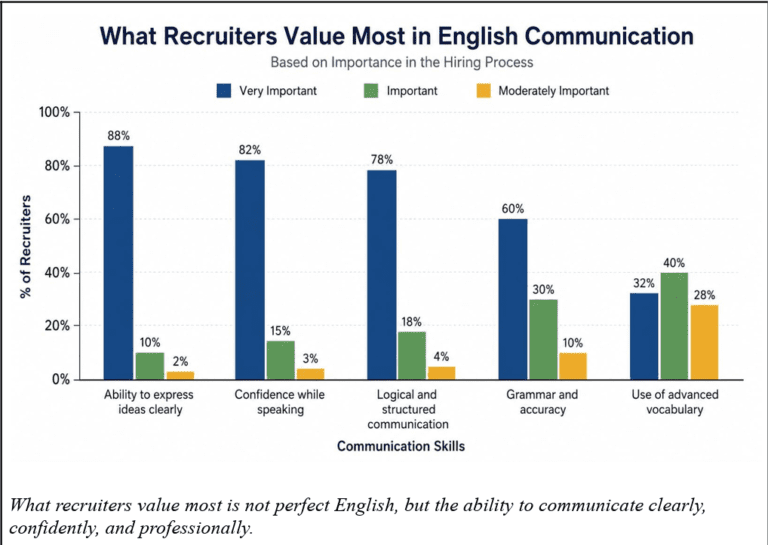
One of the most common misconceptions among job seekers is the belief that recruiters expect candidates to speak flawless, perfect English at all times. In reality, most recruiters are not evaluating you on perfection or accents. What they truly look for is effective communication—your ability to express ideas clearly, listen well, and respond with confidence. Clear, purposeful communication often matters far more than using complex words or making zero mistakes. This is why many English fluency tips focus on building confidence and clarity rather than striving for perfect grammar in every sentence.
During hiring, recruiters usually want to understand: – Can the candidate express ideas clearly? – Are they able to answer questions confidently? – Do they interact professionally? – Can they explain their thoughts logically? – Are they capable of communicating effectively with colleagues and clients?
A candidate who speaks simple English with confidence may create a stronger impression than someone who uses advanced vocabulary but struggles to communicate naturally. Professional communication is not about showing knowledge of the language. It is about using the language to demonstrate knowledge.
Why Fluency Alone Is Not Enough
Fluency is valuable, but fluency without clarity may not create the desired impact. A person may speak continuously, but if their ideas are not organised, the listener may find it difficult to understand the message. For example, during an interview, giving a long answer without structure may create confusion.
Therefore, fluency should consistently support and strengthen clear, effective communication, helping your message land better with the audience, rather than replacing clarity and purpose altogether in any conversation.
Why Accuracy Alone Is Not Enough
Accuracy is important, but excessive focus on mistakes can become a barrier. Many learners hesitate because they think: “Is my sentence grammatically correct?” “Am I using the right tense?” “Will people notice my mistake?”
This fear often prevents them from speaking. Language is a tool for interaction. If a person waits for complete perfection before speaking, they may lose valuable opportunities to practise and improve. A balanced approach allows learners to improve accuracy gradually while developing confidence.
The Importance of Communication Skills in Hiring
Modern workplaces increasingly expect employees to communicate confidently and clearly across a wide range of situations. In day-to-day roles, a professional may need to adapt their message, tone, and style depending on the audience, such as:
– Participate in meetings – Present ideas – Write emails – Solve problems with teams – Handle customers – Explain information
In these situations, communication effectiveness matters. An employee who can communicate clearly is more likely to collaborate successfully and contribute positively to the organisation. This is why recruiters often evaluate communication skills during interviews.
The Role of Confidence in Professional Communication
Confidence is a major factor that influences how communication is received. A confident speaker is more likely to: – Express opinions – Ask questions – Participate actively – Handle workplace situations
Confidence does not mean speaking without mistakes. It means having the willingness to express ideas despite minor imperfections. Many successful professionals continue to improve their language throughout their careers. They do not wait until their English becomes perfect before communicating. So they communicate, learn, and improve continuously.
The Need for a Practical Approach to English Learning
Learning English effectively involves much more than simply memorising grammar rules or collecting long lists of vocabulary. Real language skills grow steadily when learners actively practise using English in meaningful, real-life situations—such as conversations, presentations, reading everyday content, and writing short messages that reflect genuine communication.
A practical approach focuses on: – Speaking regularly – Listening actively – Learning useful expressions – Engaging in discussions – Receiving feedback – Improving gradually
The true purpose of language learning goes beyond simply gaining knowledge; it lies in applying that knowledge in real situations. A person may memorise many English words and understand their meanings, yet real progress comes from using those words correctly and naturally. Knowing when, where, and how to choose the right words is what improves clarity and builds confidence. This practical ability is what ultimately leads to effective communication.
Fluency and Accuracy in the Age of AI and Technology
With increasing use of technology and artificial intelligence, communication skills continue to remain important. Digital tools can help people write, translate, or organise information, but human interaction still requires understanding, clarity, and confidence. Professionals need to explain ideas, collaborate with teams, and build relationships. In such situations, the ability to communicate naturally becomes an important advantage. This is why English fluency tips remain highly valuable for students and professionals who want to communicate effectively in modern workplaces.
Developing the Right Balance
The ideal goal for learners should not be choosing between fluency and accuracy. Instead, both skills work together. On one hand, accuracy provides correctness, On the other hand, fluency provides confidence and flow. As a result, when combined, they create effective communication. Therefore, a learner should aim to:
A learner should aim to: – Speak without unnecessary fear – Improve mistakes through practice – Use simple and clear language – Focus on the listener’s understanding
Speak with clarity. Lead with confidence.
Master the communication skills that recruiters actually look for — not just grammar, but the ability to express ideas clearly and professionally in any situation.
English fluency and English accuracy are both essential parts of language growth. However, in most workplaces, recruiters typically prioritise strong communication skills over the impractical demand for flawless English. In fact, a candidate doesn’t have to sound like a native speaker or rely on complex vocabulary to make a good impression. Instead, what truly counts is expressing ideas in a clear, confident, and professional manner. Therefore, English learning should focus not just on speaking more or speaking correctly, but also on communicating more effectively. On one hand, fluency supports smooth speech. On the other hand, accuracy supports correct speech. Ultimately, effective communication enables a person to deliver real impact. Furthermore, many English fluency tips emphasise developing both fluency and accuracy to build stronger professional communication skills.