
These are daily life English speaking sentences used in common, everyday situations at home or with others. Sentences like “I woke up early today” talk about daily routines, “Please close the door” is a polite request, “I am having breakfast” describes a present activity, and “Let’s watch TV together” is an invitation. Practising such sentences daily helps improve fluency, clarity, and confidence in real-life communication.
1. How to Use These Daily Practice Sentences
Table of Contents
Toggle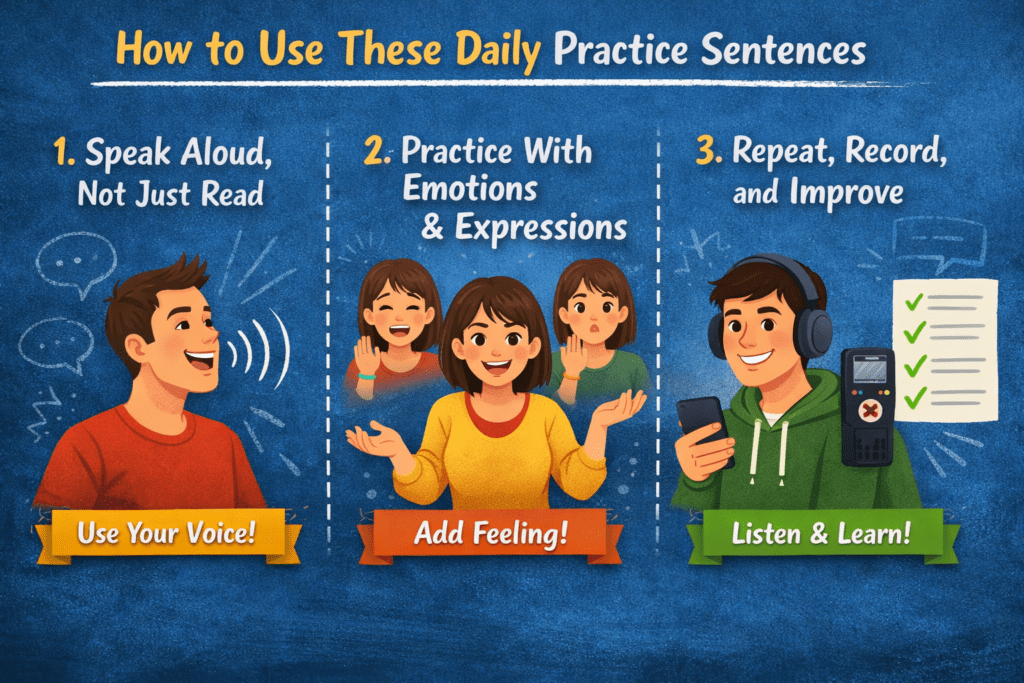
How to Use These Daily Practice Sentences means practising simple, useful sentences every day to improve your English speaking skills naturally. Start by reading each sentence aloud to work on pronunciation and clarity, then understand its meaning and how it is used in real-life situations. Repeat the sentence a few times, try using it in your own daily context, and change a few words to make new sentences. With regular practice, these sentences help you think in English, speak more fluently, and build confidence in everyday conversations.
1. Speak Aloud, Not Just Read
Reading silently may feel comfortable, but it limits real progress in spoken English. When you speak aloud, you actively train both your mouth and ears to work together, which is essential for clear pronunciation and natural fluency. Saying words out loud helps you notice sounds, stress, and rhythm, making your speech more accurate and confident. Regular speaking practice builds muscle memory, reduces hesitation, and boosts self-confidence, allowing you to express your thoughts smoothly and communicate effectively in real-life situations.
2. Practice With Emotions and Expressions
Using facial expressions, hand movements, and emotions while speaking makes your speech more natural, lively, and engaging. Gestures and expressions support your words, helping convey meaning and feelings clearly. They make your communication expressive and confident, capturing your listener’s attention and making it easier for them to connect with you. Regularly practicing speech with emotion and movement improves fluency, ensures your message is understood, and helps you communicate effectively in any situation.
3. Repeat, Record, and Improve
Repeating sentences daily, recording your voice, and listening carefully is a powerful way to improve your English. By identifying mistakes and correcting them, you train yourself to speak more accurately. Tracking your progress over time shows how much you’ve improved, builds confidence, and helps you develop better pronunciation, fluency, and clarity. Consistent practice turns mistakes into learning opportunities and strengthens your overall speaking skills effectively.
2. Daily English Speaking Practice Structure
Daily English Speaking Practice Structure is a systematic plan you can follow every day to improve your English speaking skills efficiently. It breaks your practice into clear steps so that you develop pronunciation, fluency, vocabulary, and confidence gradually.
A typical structure includes:
Warm-up: Start by reading simple sentences aloud to loosen your mouth and vocal muscles.
- Daily Sentences Practice: Speak 5–10 useful sentences, focusing on pronunciation, intonation, and expression.
- Listening & Imitation: Listen to native speakers or recordings and try to imitate their tone and rhythm.
- Recording & Review: Record yourself speaking, listen carefully, and correct mistakes.
- Vocabulary & Phrases: Learn and use 5–10 new words or expressions in sentences.
- Free Speaking: Talk about your day, thoughts, or topics of interest using what you’ve practiced.
Following this daily structure helps you build confidence, speak fluently, and make steady progress in English.
1. Morning Practice Routine
Start your day with 10–15 minutes of focused speaking practice to activate your English skills. Begin with pronunciation drills and tongue twisters to warm up your mouth and improve clarity, then practise simple daily conversation sentences. This routine prepares your voice, builds fluency, and boosts confidence, making it easier to speak smoothly and naturally throughout the day.
2. Afternoon Speaking Practice
Use the afternoon for practical application by engaging in short conversations, role-plays, or practice dialogues. This hands-on speaking time helps you apply what you’ve learned, reinforce vocabulary and sentence structures, and improve fluency. Practising in real-life contexts builds confidence and makes your English more natural and effective in everyday situations.
3. Evening Revision Practice
In the evening, review what you practised earlier by repeating key sentences and recording your voice. Listen carefully to identify and correct mistakes in pronunciation or fluency. This revision strengthens understanding, improves retention, and helps you prepare confidently for more advanced speaking practice the next day.
3. Daily English Speaking Sentences for Beginners
Daily English Speaking Sentences for Beginners are simple, commonly used sentences designed to help new learners practise speaking English every day. These sentences focus on basic vocabulary, clear sentence structure, and everyday situations like greetings, daily routines, and simple conversations. Regular practice with these sentences helps beginners improve pronunciation, build confidence, and develop fluency gradually, making it easier to communicate naturally in real-life situations.
1. Basic Greetings and Introductions
These are basic daily English speaking sentences for beginners used in simple introductions and greetings. They help learners start conversations politely and confidently. Sentences like “Hello, how are you?” and “Good morning, my name is ___” are used to greet and introduce yourself, while “Nice to meet you” shows politeness, and “Where are you from?” helps continue the conversation. Practising these sentences daily improves confidence and fluency in everyday interactions.
2. Talking About Daily Routine
These are simple daily routine sentences for beginners that help learners talk about their everyday activities. Sentences like “I wake up early every day” and “I go to work or school in the morning” describe morning habits, while “I have lunch in the afternoon” and “I relax in the evening” talk about later parts of the day. Practising these sentences regularly helps improve sentence formation, fluency, and confidence in daily conversations.
3. Expressing Likes and Dislikes
These are simple preference sentences for beginners that help learners express likes and dislikes clearly. Sentences like “I like reading books” and “I enjoy listening to music” show positive preferences, while “I don’t like waking up late” and “I dislike spicy food” express dislikes. Practising these sentences helps beginners communicate personal choices confidently and improves everyday conversational English.
4. Daily English Speaking Sentences for Daily Life
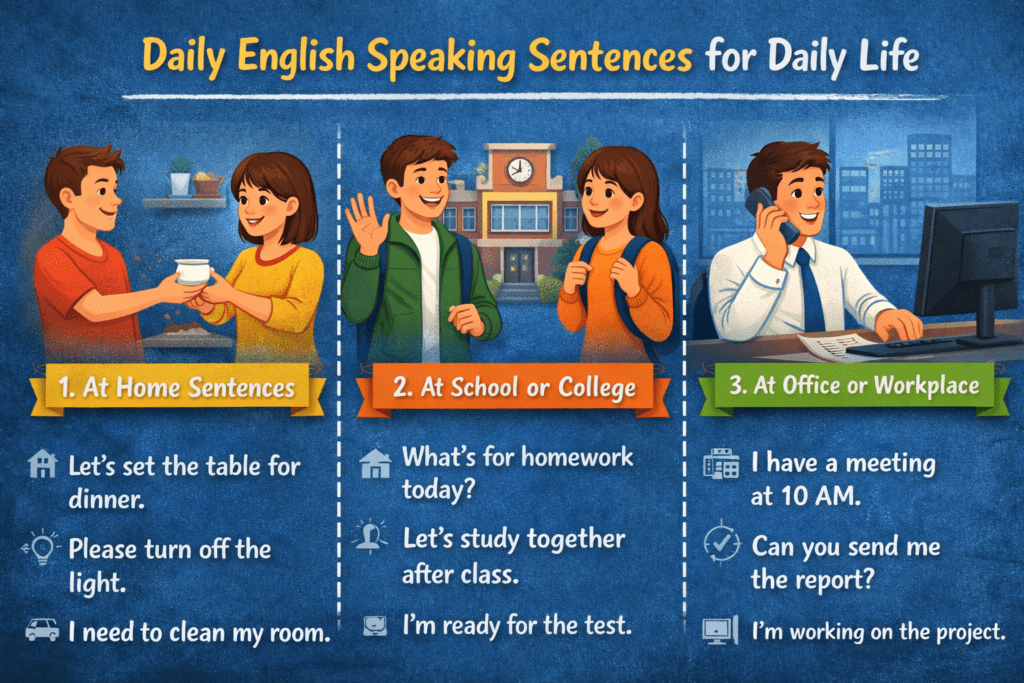
Daily English Speaking Sentences for Daily Life are simple, commonly used sentences that help learners communicate in everyday situations. These sentences cover daily routines, greetings, preferences, needs, and basic conversations used at home, work, school, or in public places. Regular practice with these sentences improves pronunciation, builds confidence, and helps learners speak English naturally and fluently in real-life situations.
1. At Home Sentences
2. At School or College
These are English speaking sentences related to school or classes that help learners talk about their academic routine. Sentences like “I have a class at ten o’clock” describe schedules, “The teacher explained the lesson well” expresses understanding, and “I need to complete my assignment” shows responsibility. Practising these sentences daily improves confidence and fluency in educational and classroom conversations.
3. At Office or Workplace
At Office or Workplace refers to English speaking sentences used in professional and work-related situations. These sentences help employees communicate clearly about tasks, meetings, and responsibilities. Using simple workplace sentences daily improves professional communication, confidence, and fluency, making interactions with colleagues and managers more effective.
5. Daily English Speaking Practice for Common Situations
Daily English Speaking Practice for Common Situations means practising simple English sentences for everyday use—at home, in the office, at school, or while shopping and travelling. By speaking these sentences daily, learners become comfortable using English in real-life situations. This regular practice improves fluency, pronunciation, and confidence, making communication natural and effortless.
1. Asking for Help
These are common English sentences for asking help in everyday situations. Sentences like “Can you help me, please?” and “I need some assistance” politely request support, while “Could you explain this to me?” and “Can you show me how to do this?” ask for clarification or guidance. Practising these sentences helps learners communicate needs confidently and politely in real-life interactions.
2. Giving Directions
These are common English sentences for giving and understanding directions. Sentences like “Go straight and turn left” guide movement, “The shop is near the bus stop” and “It is opposite the bank” describe locations, and “You will find it on the right side” helps pinpoint exact places. Practising these sentences improves your ability to ask for and give directions clearly in daily life.
3. Making Requests
These are common English sentences for making polite requests. Sentences like “Could you please help me?” and “Can I borrow your pen?” ask for assistance or items politely, while “Would you mind opening the window?” and “Please give me a moment” are courteous ways to request actions or time. Practising these sentences helps learners communicate politely and confidently in everyday situations.
6. Daily English Speaking Practice for Confidence
Daily English Speaking Practice for Confidence is the habit of speaking English every day using simple, practical sentences to overcome fear and hesitation. This practice focuses on speaking aloud, repeating useful phrases, and using English in real-life situations. Regular daily practice improves pronunciation, fluency, and clarity, helping learners feel more comfortable, confident, and natural while speaking English in conversations.
1. Expressing Opinions
These are English speaking sentences for expressing opinions that help learners share their thoughts clearly and confidently. Sentences like “I think this is a good idea” and “In my opinion, this works well” are used to give personal views, while “I believe we should try again” and “I feel this option is better” help express suggestions and preferences politely. Practising these sentences improves confidence and fluency in discussions and conversations.
2. Agreeing and Disagreeing
Agreeing and Disagreeing in English means expressing whether you support or oppose someone’s idea, opinion, or statement in a clear and polite way. Agreeing shows that you share the same view, while disagreeing means you have a different opinion. Using proper agreeing and disagreeing phrases helps you communicate respectfully, participate confidently in discussions, and express your thoughts clearly in everyday and professional conversations.
3. Talking About Feelings and Emotions
These are English speaking sentences for expressing feelings and emotions that help learners talk about how they feel in different situations. Sentences like “I feel happy today” and “I am a little nervous” express emotions, while “This makes me excited” and “I feel tired but motivated” describe mixed feelings. Practising these sentences helps improve emotional expression, confidence, and natural communication in daily conversations.
4. Handling Simple Conversations
Handling Simple Conversations means being able to start, continue, and respond in basic everyday English conversations with confidence. It includes greeting others, asking and answering simple questions, expressing opinions or feelings, and responding politely. Practising simple conversation skills helps learners communicate clearly, avoid hesitation, and interact naturally in daily and social situations.
7. Daily English Speaking Practice for Fluency

Handling Simple Conversations means being able to start, continue, and respond in basic everyday English conversations with confidence. It includes greeting others, asking and answering simple questions, expressing opinions or feelings, and responding politely. Practising simple conversation skills helps learners communicate clearly, avoid hesitation, and interact naturally in daily and social situations.
1. Long Sentence Practice
These are simple English speaking sentences for daily life and habits that help learners talk about routines, interests, and self-improvement. Sentences like “I wake up early every day and try to plan my work carefully” describe daily habits, “I enjoy learning English because it helps me communicate confidently” expresses interest and purpose, and “After finishing my work, I relax and watch videos to improve my skills” talks about activities and learning. Practising such sentences improves fluency, confidence, and natural expression.
2. Connecting Ideas While Speaking
These are English speaking sentences that combine ideas using connectors to help learners express reasons, results, and multiple actions clearly. Sentences like “I was tired, but I continued practicing because it is important” show contrast and reason, “I wanted to go out, so I finished my tasks quickly” expresses cause and result, and “I like reading books and listening to podcasts to learn new words” links activities and purpose. Practising these sentences improves sentence flow, clarity, and confidence in everyday speaking.
Learn Spoken English from GILP and Supercharge your growth
Conclusion
Consistency is the key to achieving English fluency. Speaking a little every day builds confidence, improves pronunciation, and makes sentence formation natural. Start speaking English daily, even with simple sentences and short conversations. Small, regular practice creates strong habits, and over time, these small efforts lead to big improvements in fluency and communication skills.